

- Your cart is empty Browse Shop
📌 Quick facts:
- Low stamina rarely has a single cause — poor sleep, chronic stress, poor diet, a sedentary lifestyle and age-related decline all contribute independently.
- Research on athletes has directly linked disrupted sleep-wake cycles to measurably reduced physical performance.
- Ayurveda frames most of these causes as disruptions to Ojas (vital essence) and imbalanced Vata dosha, offering a unifying lens across seemingly unrelated causes.
- Identifying which specific cause applies to you matters more than reaching for a generic “energy booster” without understanding why your stamina dropped in the first place.
“Why do I have no stamina anymore” is a common question with rarely a single answer. Low stamina is usually the cumulative result of several overlapping factors — some obvious, some easy to overlook entirely. This guide walks through the five most common causes, what research says about each, and how to start rebuilding stamina once you know which one applies to you.
Treating low stamina as a single mystery to solve with one supplement often misses the point. Identifying the actual driver — or drivers — behind it is what makes any solution, herbal or otherwise, actually work.
It’s also worth saying that these five causes rarely act in isolation. Poor sleep makes stress harder to manage. Chronic stress often leads to skipped meals or reaching for quick, processed food. A sedentary routine and poor diet frequently reinforce each other in a slow, quiet spiral. Recognising these overlaps is genuinely useful, because it means addressing even one or two causes properly can produce a bigger improvement than you might expect, simply because the factors were compounding each other in the first place.
📋 In this guide
- Why does poor sleep quietly drain stamina?
- Can chronic stress really lower physical stamina?
- Does poor diet contribute to low stamina?
- Is a sedentary lifestyle a hidden cause of low stamina?
- Can age-related decline explain reduced stamina?
- How can you rebuild stamina once you’ve found the cause?
- Frequently asked questions
Why does poor sleep quietly drain stamina?
⚡ Quick answer: A study on athletes found that disrupted sleep-wake cycles directly reduced physical performance, confirming what many people already suspect from experience. Poor sleep affects not just how tired you feel but your body’s actual physical capacity for sustained effort, day after day.
Sleep is where the body physically recovers and rebuilds — muscle repair, hormone regulation, and nervous system recovery all happen predominantly during sleep. A 2007 study published in Physiology & Behavior found that altered sleep-wake cycles directly reduced physical performance in athletes (Reilly & Edwards, 2007). If elite athletes with structured training show measurable performance drops from disrupted sleep, it’s reasonable to expect the same holds true, likely more so, for anyone with an irregular sleep schedule and no dedicated recovery routine.
Can chronic stress really lower physical stamina?
⚡ Quick answer: Yes — chronic stress keeps the body in a persistent state of heightened cortisol production, which over time interferes with recovery, sleep quality and sustained energy output. This is a well-documented physiological pathway, not just a subjective feeling of being “drained.”
Chronic stress keeps cortisol — the body’s primary stress hormone — elevated for extended periods, which interferes with muscle recovery, disrupts sleep quality, and diverts the body’s resources toward managing perceived threat rather than building physical capacity. Someone under constant work or personal stress often notices declining stamina even without any change to diet or exercise, precisely because stress itself is quietly working against physical recovery in the background. This is often the most confusing cause to identify, because nothing about your routine has visibly changed — the stamina simply drains away while everything else on the surface looks the same, which is exactly why chronic stress deserves specific attention rather than being dismissed as unrelated to physical energy.
Does poor diet contribute to low stamina?
⚡ Quick answer: Yes — inconsistent meals, excess processed food, and inadequate protein or micronutrient intake directly limit the body’s fuel and building blocks for sustained energy. Stamina is, at a basic level, a function of how well and how consistently the body is fed.
Stamina requires consistent fuel — skipped meals, excess sugar and processed food, and inadequate protein all limit the body’s ability to sustain energy output over the course of a day. This is one of the more genuinely fixable causes on this whole list: small, consistent improvements to meal regularity and food quality often produce a noticeable stamina improvement faster than most other changes, simply because the body finally has reliable, steady fuel to work with each day.
Is a sedentary lifestyle a hidden cause of low stamina?
⚡ Quick answer: Yes — paradoxically, low physical activity itself reduces stamina over time, since the cardiovascular and muscular systems lose conditioning without regular use. Many people mistake fatigue for a reason to rest more, when moderate activity is often exactly what stamina needs.
This cause is genuinely counterintuitive: less activity leads to less stamina, not more energy in reserve. Cardiovascular fitness and muscular endurance both decondition fairly quickly without regular use, meaning a sedentary routine actively erodes the physical capacity needed for sustained effort. Breaking this cycle usually starts small — brief daily walks or light activity — rather than jumping straight into intense exercise, which can easily backfire and discourage you further if stamina is already quite low to begin with.
Can age-related decline explain reduced stamina?
⚡ Quick answer: Some natural decline in stamina with age is expected, but it’s frequently overestimated as the sole cause when sleep, stress, diet or inactivity are actually doing most of the damage. Ayurveda addresses age-related decline as one factor among several, not an excuse to stop investigating further.
Age does play a genuine role in gradually declining stamina, but it’s commonly used as a catch-all explanation that lets the other four causes go unexamined. Someone in their 40s with poor sleep, chronic stress, inconsistent diet and a sedentary routine will likely see a much bigger stamina improvement from addressing those four factors than from anything specifically targeting “age” as a standalone cause. Age matters, but it’s rarely the whole story. Before accepting age as the final explanation, it’s worth honestly reviewing sleep quality, stress levels, meal consistency and physical activity over the past few months — for most people, at least one of these turns out to be a bigger, more fixable factor than age itself.
How can you rebuild stamina once you’ve found the cause?
⚡ Quick answer: Address the specific cause directly — consistent sleep, stress management, regular balanced meals, gradual movement, and, where appropriate, classical Ayurvedic herbal support. Combining lifestyle changes with herbal support tends to work better than relying on either approach alone, over the following weeks.
Once you’ve identified which of these five causes applies most to you — often it’s more than one — the rebuilding process is fairly direct: prioritize consistent sleep, actively manage stress, eat regular balanced meals, and reintroduce gradual movement if you’ve been sedentary. Classical Ayurvedic herbal formulations are traditionally used alongside these changes, supporting the body’s capacity to recover and sustain energy, rather than working as a standalone fix for a problem with multiple root causes.
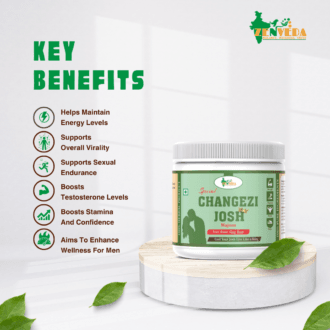
Changezi Josh Majoon by Zen Veda is a herbal formulation traditionally used to support stamina, energy and everyday vigour, built on Yarsa Gumba, saffron and safed musli. Explore our wider range of Ayurvedic wellness products, or read more on our About Us page.
Want help identifying what’s actually behind your low stamina? Book a free consultation with our Vaidyas.
Frequently asked questions
What is the most common cause of low stamina?
There’s rarely a single most common cause — poor sleep, chronic stress, inconsistent diet, low physical activity and age-related decline usually overlap and compound one another.
Can better sleep alone improve stamina?
Sleep is one of the most impactful single changes, since research links disrupted sleep-wake cycles directly to reduced physical performance, though other factors still matter too.
Does exercise help or hurt low stamina?
Moderate, gradually increasing activity genuinely helps, since a sedentary lifestyle itself contributes to declining stamina over time, though jumping into intense exercise too quickly can backfire.
Is low stamina always related to age?
No, age plays some role but is often overestimated as the sole cause when sleep, stress, diet or inactivity are actually the larger contributors.
How does Ayurveda explain low stamina?
Ayurveda frames low stamina as disrupted Ojas (vital essence) and imbalanced Vata dosha, offering a unifying classical framework across these varied modern causes.
How long does it take to rebuild stamina?
Most people notice gradual improvement over several weeks of consistent changes to sleep, stress, diet and activity, rather than an immediate or overnight difference.
📚 Sources
1. Reilly, T. & Edwards, B. “Altered sleep-wake cycles and physical performance in athletes.” Physiology & Behavior, 2007. PubMed 17067642
2. Charaka Samhita — classical description of Ojas (vital essence) and its relationship to strength and stamina.
3. Ashtanga Hridayam — classical Ayurvedic reference for Vata dosha balance and daily energy.
2. Charaka Samhita — classical description of Ojas (vital essence) and its relationship to strength and stamina.
3. Ashtanga Hridayam — classical Ayurvedic reference for Vata dosha balance and daily energy.
Disclaimer: This article is for educational purposes only and is not a substitute for personalised medical advice. Individual results vary. Please consult a qualified Ayurvedic practitioner or your healthcare provider before starting any new treatment, especially if you are managing a medical condition or taking medication.
★ 6,500+ happy customers
Ready to start your Ayurvedic hair journey?
Our Vaidyas build personalised herbal routines for you. Free consultation, no obligation.
For Free Consultation Contact +919548121325, +919149171737 | International business inquiry: sahil@zenveda.co.in / +919548121325
Recommended Zen Veda products
Author
