








- Your cart is empty Browse Shop
📌 Quick facts:
- A 2008 study in Archives of Dermatological Research compared Bhringraj (Eclipta alba) extract with Minoxidil 2% — the standard chemical hair-regrowth drug.
- The Bhringraj petroleum-ether extract (2% and 5%) produced more hair follicles in the active growth (anagen) phase than Minoxidil 2% in the animal model.
- Bhringraj cut the time for hair to start regrowing to roughly half that of untreated skin.
- Classical Ayurveda has called Bhringraj Kesharaja — “the king of hair” — for over a thousand years.
Rohit noticed it first on a video call. In the harsh ring-light of his laptop camera, the crown of his head looked thinner than he remembered. He was thirty-two, ate reasonably well, and had no family history of early balding — yet the drain in his bathroom told a different story every morning. His dermatologist suggested Minoxidil. He tried it for four months. The shedding slowed, but he hated the greasy scalp, the itchy flakes, and the quiet fear of what would happen the day he stopped.
That last part is the catch nobody mentions at the pharmacy counter: Minoxidil works only as long as you keep using it. If that sounds like your morning, the debate of Bhringraj vs Minoxidil is worth understanding properly — what each one does to your scalp, what the evidence says, and which approach fits a life you can sustain for years, not weeks.
📋 In this guide
- Why does hair fall so much faster than it grows back?
- What did the 2008 Bhringraj vs Minoxidil study find?
- Is Bhringraj genuinely better than Minoxidil?
- How do you actually use Bhringraj oil for regrowth?
- Which Zen Veda oil should you choose?
- What results can you realistically expect?
- Frequently asked questions
Why does hair fall so much faster than it grows back?
⚡ Quick answer: Hair falls faster than it regrows when DHT, chronic stress, and poor scalp circulation push too many follicles into the resting phase at once. Ayurveda reads this as aggravated Pitta overheating the roots, which is why the classical remedy is a cooling, nourishing oil ritual rather than a single quick fix.
Every strand lives on a cycle: a growth phase (anagen) that can last years, a short transition, and a resting-and-shedding phase (telogen). Losing 50–100 hairs a day is normal. Trouble begins when too many follicles enter rest at once and too few climb back into active growth. DHT shrinks genetically sensitive follicles, cortisol from chronic stress nudges them into early rest, and poor circulation starves the root of nutrients.
Ayurveda mapped this pattern long before follicle biology had a name, reading heavy hair fall as aggravated Pitta “cooking” the roots. The Ashtanga Hridayam prescribes Murdha Taila — regular head oiling — as daily preventive care, while the Charaka Samhita groups certain herbs as keshya, meaning hair-strengthening. Bhringraj sits at the very top of that list, which is exactly why it keeps surfacing in modern hair research.
What did the 2008 Bhringraj vs Minoxidil study find?
⚡ Quick answer: In the 2008 rat study published in Archives of Dermatological Research, Bhringraj’s petroleum-ether extract at 5% grew more anagen-phase follicles than Minoxidil 2%, and halved the time hair took to start regrowing. The authors concluded the herbal extract performed better than the Minoxidil control.
Here is the research most blogs skip. In 2008, Roy, Thakur and Dixit published “Hair growth promoting activity of Eclipta alba in male albino rats” in Archives of Dermatological Research (2008;300(7):357–364). They tested Bhringraj extracts head-to-head against Minoxidil 2% — the same molecule sold in most over-the-counter regrowth solutions. The petroleum-ether extract at 5% produced roughly 69 anagen-phase follicles against about 47 in controls, and the authors stated the 2% and 5% formulations “were better than the positive control Minoxidil 2% treatment.” You can read the record on PubMed (ID 18478241).
Is Bhringraj genuinely better than Minoxidil?
⚡ Quick answer: Bhringraj beat Minoxidil on follicle counts in the lab, but real life is about fit, not a single winner. Bhringraj nourishes the root and holds its gains without rebound, while Minoxidil acts faster yet only works while you keep applying it. For sustainable, everyday care, Bhringraj is the stronger long-term choice.
| Factor | Bhringraj (Eclipta alba) | Minoxidil 2% |
|---|---|---|
| Origin | Ayurvedic herb, used 1,000+ years | Synthetic pharmaceutical |
| 2008 study result | More anagen follicles (~69) | Fewer (positive control, ~47) |
| How it works | Nourishes the root & cools the scalp | Stimulates blood flow to follicles |
| When you stop | Gains tend to hold | Shedding rebound is common |
| Common side effects | Rare (patch test advised) | Itching, flaking, dryness |
| Best suited for | Sustainable, long-term care | Fast, medical-grade intervention |
Two honest caveats matter. This was an animal study, not a large human trial, so it shows biological promise rather than a guarantee for every person. And “better than Minoxidil in rats” is no reason to abandon a treatment your practitioner prescribed. What the study does establish is that Bhringraj is not folklore dressed up as science — it has a measurable, follicle-level mechanism, and it nourishes rather than merely stimulating.
How do you actually use Bhringraj oil for regrowth?
⚡ Quick answer: Warm the Bhringraj oil, massage it into the scalp with fingertips for five to ten minutes, and leave it on for at least ninety minutes or overnight, twice a week. Wash with a mild, sulphate-free cleanser, and give the routine a fair twelve to sixteen weeks before judging results.
- Warm the oil. Slightly warm oil opens the scalp and helps the actives penetrate — comfortably warm to the fingertip, never scalding.
- Massage 5–10 minutes. Use fingertips, not nails, in small circles to improve the scalp circulation thinning follicles are starved of.
- Leave it on. At least 60–90 minutes, or overnight twice a week for stubborn shedding. Protect the pillow with an old towel.
- Wash gently. A mild, sulphate-free cleanser preserves the calming effect; harsh shampoos strip the scalp.
- Stay consistent. Track honestly with a monthly crown photo taken in the same light.
Which Zen Veda oil should you choose?
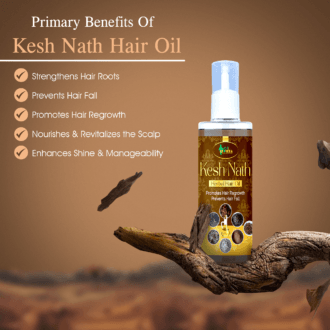
⚡ Quick answer: Zen Veda’s Kesh Vidhi Regrowth Hair Oil is built around Uttarakhand-sourced Bhringraj, blended in the classical keshya tradition with herbs that cool Pitta and feed the follicle. It suits anyone wanting the follicle-level benefit the 2008 research points to, without the greasy dependence and rebound worry of a lifelong chemical.
Sourcing matters enormously with a herb like Bhringraj — potency depends on where and how it is grown. Zen Veda’s Kesh Vidhi Regrowth Hair Oil uses Bhringraj from the Uttarakhand hills, blended with supporting keshya herbs. Used as part of the twice-weekly ritual above, it is a regrowth routine, not a quick fix — which is precisely why results tend to hold. You can also explore the full Zen Veda hair-care range to build a complete routine around it.
What results can you realistically expect?
⚡ Quick answer: Expect reduced shedding first, usually within four to six weeks of consistent use, with visible regrowth at thinning areas taking three to four months or longer. Because Bhringraj nourishes rather than merely stimulates, the gains you build tend to hold even if you later ease off the routine.
Hair grows slowly, so patience is part of the method. Reduced fall during washing and combing is the earliest, most encouraging sign. Regrowth of finer “baby hairs” along the hairline and crown follows later. The people who see the best outcomes are simply the ones who stay consistent through the first few months and cool their aggravated Pitta with steadier sleep, less heat and adequate water. If you would like this tailored to your dosha, you can book a free consultation with our Vaidyas.
Frequently asked questions
Is Bhringraj really better than Minoxidil for hair regrowth?
In the 2008 animal study, Bhringraj extract produced more follicles in the growth phase than Minoxidil 2%. In real life, Bhringraj nourishes the follicle and is sustainable long-term without rebound, while Minoxidil can act faster but only works while you keep using it. Many people use Bhringraj as their maintainable, everyday approach.
How long does Bhringraj oil take to show results?
Because hair grows on a slow cycle, give it 12–16 weeks of consistent twice-weekly use before judging. Reduced shedding is usually the first sign; visible regrowth at thinning areas takes longer.
Does Bhringraj have side effects like Minoxidil?
Bhringraj oil is generally well tolerated and does not carry Minoxidil’s common complaints of scalp itching, flaking, or the shedding rebound when you stop. As with any botanical, do a small patch test first if you have sensitive skin or known allergies.
Can I use Bhringraj oil and Minoxidil together?
Some people do, using the oil on non-Minoxidil days for nourishment. If you are on a prescribed treatment, speak to a qualified Ayurvedic practitioner before combining, so the routine and timing are set up correctly for your scalp.
How often should I apply Bhringraj oil for hair fall?
Twice a week is a sensible baseline, increasing to three times for heavy seasonal shedding such as during the monsoon. Warm it, massage 5–10 minutes, and leave on for at least 60–90 minutes or overnight.
📚 Sources
1. Roy RK, Thakur M, Dixit VK. “Hair growth promoting activity of Eclipta alba in male albino rats.” Archives of Dermatological Research, 2008;300(7):357–364. PubMed 18478241
2. Ashtanga Hridayam & Charaka Samhita — classical Ayurvedic references on keshya (hair-promoting) herbs and Murdha Taila (head oiling).
2. Ashtanga Hridayam & Charaka Samhita — classical Ayurvedic references on keshya (hair-promoting) herbs and Murdha Taila (head oiling).
★ 6,500+ happy customers
Ready to start your Ayurvedic hair journey?
Our Vaidyas build personalised herbal routines for you. Free consultation, no obligation.
For Free Consultation Contact +919548121325, +919149171737 | International business inquiry: sahil@zenveda.co.in / +919548121325
Recommended Zen Veda products
Author

5 Comments
7 Silent Symptoms of High Blood Pressure
July 10, 2026[…] Bhringraj vs Minoxidil: what the 2008 study found […]
Fatty Liver on Your Report? What to Do Next
July 10, 2026[…] Bhringraj vs Minoxidil: what the 2008 study found […]
Is Losing This Much Hair While Bathing Normal?
July 10, 2026[…] Bhringraj vs Minoxidil: what the 2008 study found […]
White Discharge: When Is It Normal and When Not?
July 10, 2026[…] Bhringraj vs Minoxidil: what the 2008 study found […]
Why We Forget Self-Care (and How to Fix It)
July 10, 2026[…] Bhringraj vs Minoxidil: what the 2008 study found […]