



- Your cart is empty Browse Shop
📌 Quick facts:
- Yarsagumba (keeda jadi) is a caterpillar fungus from high Himalayan meadows — one of the world’s most expensive natural substances.
- Traditionally prized as a stamina and vitality tonic, it contains genuinely bioactive compounds like cordycepin.
- A 2010 human trial found Cordyceps improved aerobic endurance thresholds by 8–10% — though not peak (VO₂ max) capacity.
- The evidence is promising but limited, and the market is full of fakes — so authenticity matters enormously.
Few natural remedies carry as much mystique — or as much marketing hype — as Yarsagumba. Called keeda jadi (the “insect herb”) in India and “Himalayan gold” by traders, it sells for more than its weight in silver, and every seller promises it will transform your energy, stamina and manhood overnight. That is exactly why it deserves an honest, evidence-based look rather than another breathless sales pitch. So let us set aside both the hype and the cynicism and ask a simple question: what does the science actually say?
The short version is that Yarsagumba is neither a miracle nor a myth. It is a genuinely bioactive substance with real traditional use and some promising early research — alongside a great deal of exaggeration and a serious fake-product problem. Here is the balanced picture.
📋 In this guide
What is Yarsagumba (Keeda Jadi)?
⚡ Quick answer: Yarsagumba — keeda jadi, or caterpillar fungus — is a rare Himalayan organism formed when a fungus (Ophiocordyceps sinensis) infects and mummifies a caterpillar underground. Harvested from high-altitude meadows in Nepal, Tibet, Sikkim and Uttarakhand, it is one of the world’s most expensive natural substances, prized for centuries as a tonic for energy and vitality.
Yarsagumba’s origin is as strange as its reputation. A parasitic fungus infects the larva of a ghost moth living in the soil of high Himalayan grasslands, slowly consuming it and eventually sprouting a slender, dark stalk out of the caterpillar’s mummified head. That fused creature — half insect, half fungus — is harvested by hand each spring from altitudes above 3,000 metres in Nepal, Tibet, Bhutan, Sikkim and parts of Uttarakhand. Its extreme rarity, difficult harvest and soaring demand have made it one of the most valuable biological commodities on earth, sometimes costing more per gram than gold. Botanically, it is a close relative of the cordyceps mushrooms now sold worldwide.
What are Yarsagumba’s traditional benefits?
⚡ Quick answer: In Himalayan and Tibetan medicine, Yarsagumba has long been used as a rejuvenating tonic — for stamina, physical energy, libido, recovery from illness, and healthy ageing. Local healers in Sikkim reportedly use it for around twenty different ailments. Its reputation as a natural vitality and stamina booster is what earns it the nickname ‘Himalayan gold’.
Interestingly, Yarsagumba does not appear in the classical Ayurvedic texts such as the Charaka Samhita or Ashtanga Hridayam — it belongs to the Himalayan, Tibetan and Sikkimese folk traditions rather than mainstream classical Ayurveda. Yet it is used today within the very same rasayana (rejuvenative) and vajikarana (vitality) framework those texts established. In its home traditions it has been valued as an all-purpose tonic for physical stamina, energy, libido, recovery after illness and longevity. A review of its use in Sikkim noted that local healers recommend it for around twenty different conditions — a breadth of claims that is itself a clue to treat the folklore with respectful caution.
What does the science actually say about Yarsagumba?
⚡ Quick answer: Honestly, the evidence is promising but still limited. Yarsagumba contains genuinely bioactive compounds like cordycepin, and lab studies suggest antioxidant, immune-supporting and energy-related effects. But large, rigorous human trials are scarce, and reviewers openly call for more clinical study. It is a real, active substance — not proven magic, and not empty folklore either.
This is where honesty matters. Yarsagumba genuinely contains active compounds — cordycepin, polysaccharides and others — and laboratory and animal studies point to antioxidant, immune-modulating and energy-related activity. But when Panda and Swain reviewed the evidence in the Journal of Ayurveda and Integrative Medicine (2011;2(1):9–13), their conclusion was refreshingly candid: the traditional uses are extensive, but robust clinical proof is thin, and they explicitly called for “more mechanism-based and disease-oriented clinical studies.” In other words, this is a real, pharmacologically active organism whose folklore outruns its clinical evidence. That is very different from saying it does nothing — but it is also a long way from the miracle claims on many labels. Read the review on PubMed (ID 21731381).
Does Yarsagumba really boost energy and stamina?
⚡ Quick answer: There is early human evidence for stamina. A 2010 double-blind trial gave healthy older adults a Cordyceps supplement for twelve weeks; their aerobic thresholds improved by around 8–10 percent, meaning they could sustain effort longer — though peak capacity (VO2 max) did not change. So Yarsagumba may support endurance and steady energy more than raw, maximal power.
| Common claim | What the evidence suggests |
|---|---|
| Boosts endurance & stamina | Early human trial: aerobic thresholds up ~8–10% |
| Makes you superhumanly strong | No change in peak power (VO₂ max) in that trial |
| Instant aphrodisiac (“Himalayan Viagra”) | Traditional claim; little rigorous human proof |
| Cures dozens of diseases | Overreach — reviewers call for real clinical studies |
The most encouraging hard evidence is about endurance. In a double-blind, placebo-controlled trial published in the Journal of Alternative and Complementary Medicine (2010;16(5):585–590), Chen and colleagues gave 20 healthy older adults a standardised Cordyceps supplement (Cs-4) for twelve weeks. Their metabolic and ventilatory thresholds — the point at which sustained effort becomes hard — improved by roughly 8 to 10 percent, while the placebo group did not change. Tellingly, their maximum oxygen capacity (VO₂ max) did not improve. The practical takeaway is nuanced and realistic: Yarsagumba appears to help you sustain moderate effort for longer, supporting everyday stamina and energy, rather than turning you into an elite athlete overnight.
Is Yarsagumba safe, and how do you spot fakes?
⚡ Quick answer: Yarsagumba is generally considered safe in traditional doses, but because it is so rare and costly, the market is flooded with fakes and adulterated products. Genuine wild Yarsagumba is scarce and expensive; much of what is sold cheaply is not the real thing. Sourcing and authenticity matter more here than with almost any other ingredient.
For a healthy adult, Yarsagumba used in traditional amounts has a long history of safe use, though anyone pregnant, on medication, or managing a medical condition should consult a practitioner first. The bigger real-world risk is not the fungus itself but fraud. Because genuine wild Yarsagumba is so scarce and expensive, the market is awash with cheap imitations — moulded flour-and-starch fakes, unrelated fungi, or heavily adulterated powders. If a product is suspiciously cheap, it almost certainly is not real Yarsagumba. This is precisely why buying it as a raw curio from an unknown seller is risky, and why a trusted, properly formulated product from a transparent brand is the safer route.
How does Zen Veda use Yarsagumba?
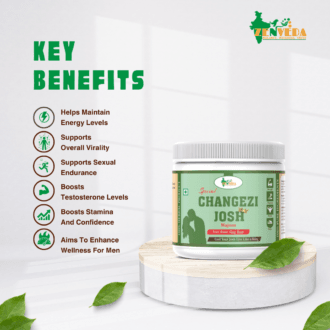
⚡ Quick answer: Zen Veda’s Changezi Josh is a men’s vitality majoon built around genuine Yarsa Gumba, blended with saffron, safed musli and honey and taken as a quarter-spoon with warm milk at night. Rather than selling raw fungus of uncertain origin, it delivers Yarsagumba within a balanced, traditional formula designed to support stamina, energy and confidence.
Given how much fake Yarsagumba circulates, the sensible way to use it is inside a trusted, complete formula rather than as a raw ingredient of unknown origin. Zen Veda’s Changezi Josh is built around genuine Yarsa Gumba, combined with saffron, safed musli, Tal Makhana and honey into a traditional men’s majoon taken as a quarter-spoon with warm milk at night. The whole-formula approach means the Yarsagumba works alongside complementary vitality herbs, in the balanced tradition Ayurveda and Unani have always favoured. Explore the wider Zen Veda range for more men’s wellness options.
Curious whether it suits you? You can book a free consultation with our Vaidyas for honest, no-hype guidance.
Frequently asked questions
What is Yarsagumba used for?
Traditionally, Yarsagumba is used as a vitality tonic — for stamina, physical energy, libido, recovery and healthy ageing. Modern evidence most supports its role in endurance and steady energy, while many other traditional claims still await rigorous clinical study.
Does Yarsagumba really work?
It is genuinely bioactive, not a placebo — a 2010 trial showed a Cordyceps supplement improved aerobic endurance thresholds. But the wilder “miracle cure” claims are not proven. Think of it as a real stamina-supporting tonic with promising but still-limited science.
Is Yarsagumba the same as cordyceps?
Closely related. Yarsagumba is the wild Himalayan caterpillar fungus (Ophiocordyceps sinensis), while “cordyceps” supplements are often cultivated relatives or strains like Cs-4. They share many bioactive compounds, but wild Yarsagumba is far rarer and costlier.
How do you take Yarsagumba?
Traditionally it is taken in small amounts, often steeped in warm milk or combined into a tonic formula, usually at night. In a product like Changezi Josh, the dose is a quarter-spoon with warm milk. Always follow the product’s guidance.
Why is Yarsagumba so expensive?
It grows only in specific high-altitude Himalayan meadows, cannot be farmed easily, and must be hand-collected in a short spring season. That scarcity, combined with huge demand, makes genuine Yarsagumba one of the priciest natural substances in the world — and a magnet for fakes.
📚 Sources
1. Panda AK, Swain KC. “Traditional uses and medicinal potential of Cordyceps sinensis of Sikkim.” Journal of Ayurveda and Integrative Medicine, 2011;2(1):9–13. PubMed 21731381
2. Chen S, Li Z, Krochmal R, et al. “Effect of Cs-4 (Cordyceps sinensis) on exercise performance in healthy older subjects: a double-blind, placebo-controlled trial.” Journal of Alternative and Complementary Medicine, 2010;16(5):585–590. PubMed 20804368
3. Charaka Samhita & Ashtanga Hridayam — classical Ayurvedic references for the rasayana framework within which Himalayan tonics are used.
2. Chen S, Li Z, Krochmal R, et al. “Effect of Cs-4 (Cordyceps sinensis) on exercise performance in healthy older subjects: a double-blind, placebo-controlled trial.” Journal of Alternative and Complementary Medicine, 2010;16(5):585–590. PubMed 20804368
3. Charaka Samhita & Ashtanga Hridayam — classical Ayurvedic references for the rasayana framework within which Himalayan tonics are used.
★ 6,500+ happy customers
Ready to start your Ayurvedic hair journey?
Our Vaidyas build personalised herbal routines for you. Free consultation, no obligation.
For Free Consultation Contact +919548121325, +919149171737 | International business inquiry: sahil@zenveda.co.in / +919548121325
Recommended Zen Veda products
Author

1 Comment
Why Do You Feel Tired All the Time? Real Causes
July 10, 2026[…] Yarsagumba (Keeda Jadi): what science actually says […]