









- Your cart is empty Browse Shop
📌 Quick facts:
- Chronic stress genuinely affects relationships, not just individual mood — it shapes patience, communication and emotional availability day to day.
- A 2019 study confirms perceived stress is meaningfully linked to lower relationship satisfaction across couples generally.
- Stress often quietly shows up in relationships as irritability or withdrawal, rather than being named directly and clearly as “stress.”
- Ayurveda connects chronic stress to Vata imbalance, which is traditionally linked to anxiety, restlessness and scattered attention.
Stress rarely stays neatly contained to just work or one single part of life alone — it tends to spill quietly into relationships in ways that are genuinely easy to misread as something else entirely, like a partner “just being distant” or “always irritable lately.” This guide explains clearly how stress genuinely affects relationships, what the available research actually shows, and how Ayurveda frames chronic stress and its wider ripple effects on daily life, patience and connection.
Recognising this connection clearly matters because unaddressed, unacknowledged stress often gets misattributed to the relationship itself, leading to unnecessary conflict about the wrong root cause entirely, when the actual issue is an overloaded nervous system rather than a genuine incompatibility between two people. Many arguments that seem, on the surface, to be about the relationship itself are, on closer inspection, actually about neither partner having enough capacity left to handle a minor disagreement calmly.
📋 In this guide
- Does stress actually affect relationship satisfaction?
- Why is stress so often misread as a relationship problem?
- How does chronic stress specifically wear down connection over time?
- Can talking about stress openly actually help?
- What practical steps help manage stress before it affects a relationship?
- How does Ayurveda understand the link between stress and relationships?
- Frequently asked questions
Does stress actually affect relationship satisfaction?
⚡ Quick answer: Yes. A 2019 study found a meaningful link between perceived stress and relationship satisfaction, confirming stress isn’t confined to the person experiencing it — it measurably affects how satisfied both partners feel in the relationship overall, not just the individual carrying the stress.
A 2019 study published in the International Journal of Fertility & Sterility examined the relationship between perceived stress and marital satisfaction, finding a meaningful connection between the two using an actor-partner interdependence model — meaning one partner’s stress genuinely affects the other’s satisfaction, not just their own (Ahmadi et al., 2019). This confirms something many couples sense intuitively but rarely name directly: stress isn’t a private, contained experience that stays with one person — it ripples outward into the shared emotional space of the relationship. Treating a partner’s stress as purely “their problem” to manage alone overlooks how directly it ends up shaping the day-to-day experience of the relationship for both people, often in ways neither partner consciously notices happening in the moment.
Why is stress so often misread as a relationship problem?
⚡ Quick answer: Stress rarely announces itself directly — it usually shows up as irritability, short temper, withdrawal or reduced patience, which can easily be mistaken for a partner’s genuine feelings about the relationship rather than a symptom of an overloaded, exhausted nervous system.
Stress rarely announces itself clearly — a stressed person doesn’t usually say “I’m overwhelmed, please be patient with me.” Instead, it shows up sideways: shorter patience, withdrawal, snapping over something minor, or seeming distracted and disengaged during conversations that deserve full attention. A partner on the receiving end can easily misread these behaviours as genuine disinterest or dissatisfaction with the relationship itself, when the actual cause is an overloaded nervous system that has nothing left to give in the moment, regardless of who’s asking. Recognising this pattern in the moment, rather than after the fact, is one of the more useful relationship skills a couple can build together over time.
How does chronic stress specifically wear down connection over time?
⚡ Quick answer: Chronic stress reduces the mental and emotional bandwidth available for genuine listening, patience and shared activities, gradually eroding connection through many small moments of disengagement rather than one dramatic event. This slow erosion is often harder to notice — and address — than an obvious single conflict.
Chronic stress doesn’t usually damage a relationship through one dramatic event — it wears it down gradually, through many small moments of reduced presence. A stressed mind has less bandwidth for genuinely attentive listening, less patience for minor friction, and less energy for the small shared rituals — a proper conversation over dinner, checking in about each other’s day, a shared laugh over something trivial — that quietly sustain closeness over time. Because this erosion happens gradually and quietly, it’s often harder to notice, name and address than a single obvious conflict would be, which is exactly what makes it worth paying deliberate attention to, well before it becomes something either partner feels they need to bring up as a larger, more difficult conversation.
Can talking about stress openly actually help?
⚡ Quick answer: Yes — naming stress explicitly, rather than letting a partner guess at the cause of irritability or distance, helps prevent misattribution and gives both people a shared, accurate understanding of what’s actually happening, rather than each person forming their own incorrect explanation.
Simply naming stress out loud — “I’m genuinely overwhelmed with work right now, and it’s not about us” — does real, practical work in a relationship, more than most people give it credit for. It replaces a partner’s guesswork, which often defaults to a more personal, relationship-focused explanation, with an accurate shared understanding of what’s actually happening. This doesn’t fix the underlying stress itself, but it prevents the secondary damage of a partner internalising behaviour that was never really about them in the first place, which is often where the deeper relationship harm actually accumulates over time, quietly and without either person fully realising it’s happening.
What practical steps help manage stress before it affects a relationship?
⚡ Quick answer: Regular physical activity, adequate sleep, brief daily check-ins with a partner, and protecting a few minutes of undistracted, phone-free time together are practical, low-effort steps that help buffer a relationship from the ongoing spillover effects of everyday stress and pressure.
A few practical habits genuinely help buffer relationships from stress spillover. Regular physical activity and adequate sleep both directly reduce baseline stress reactivity, making a short temper less likely in the first place. Brief, consistent daily check-ins — even five honest minutes without any distractions — help partners stay attuned to each other’s actual state rather than assuming or guessing. Protecting a short window of undistracted, phone-free time together each day, even briefly, preserves the kind of genuine connection that stress otherwise quietly crowds out over weeks and months.
How does Ayurveda understand the link between stress and relationships?
⚡ Quick answer: Ayurveda connects chronic stress to Vata dosha imbalance, traditionally associated with anxiety, scattered attention and restlessness — all of which naturally affect presence and patience within a relationship. Supporting Vata balance through routine, rest and calming practices is the traditional recommended approach.
Classical Ayurveda associates chronic stress with an aggravation of Vata dosha, the principle linked to movement, nervous system activity and, when imbalanced, anxiety and scattered attention. It’s not difficult to see how a Vata-imbalanced state — restless, anxious, mentally scattered, prone to overthinking — would naturally affect presence and patience within any close relationship, romantic or otherwise. The traditional approach centres on grounding routines, adequate rest, calming daily practices and consistent self-care, treating a settled nervous system as foundational to genuinely being present with another person, rather than something separate from the relationship itself.
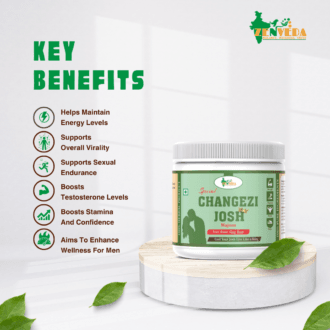
Changezi Josh by Zen Veda is a men’s vitality majoon traditionally used to support stamina, energy and everyday resilience as part of a consistent daily routine. Explore our wider range of Ayurvedic wellness products, or read more on our About Us page.
Want personalised guidance for your wellness routine? Reach out to our team.
Frequently asked questions
Does stress really affect relationships?
Yes, research confirms perceived stress is meaningfully linked to lower relationship satisfaction overall, affecting both partners, not only the person directly under stress.
Why does stress often look like a relationship problem?
Stress usually shows up as irritability or withdrawal rather than being named directly and clearly, which a partner can easily misread as genuine disinterest.
Can naming stress out loud actually help a relationship?
Yes, it replaces a partner’s guesswork with an accurate shared understanding, preventing behaviour from being wrongly internalised as personal.
What helps reduce stress spillover into a relationship?
Regular exercise, adequate sleep, daily check-ins and protected undistracted time together all help buffer a relationship from stress.
How does Ayurveda explain stress and relationship strain?
Ayurveda links chronic stress to Vata dosha imbalance, addressed through grounding routine, rest and calming daily practices.
📚 Sources
1. Ahmadi, S. et al. “The Relationship between Perceived Stress and Marital Satisfaction in Couples with Infertility: Actor-Partner Interdependence Model.” International Journal of Fertility & Sterility, 2019. PubMed 30644247
2. Charaka Samhita — classical description of Vata dosha and its relationship to anxiety and mental scatter.
3. Ashtanga Hridayam — classical Ayurvedic reference on grounding routines and nervous system balance.
2. Charaka Samhita — classical description of Vata dosha and its relationship to anxiety and mental scatter.
3. Ashtanga Hridayam — classical Ayurvedic reference on grounding routines and nervous system balance.
Disclaimer: This article is for educational purposes only and is not a substitute for professional medical or relationship counselling advice. Individual circumstances vary. If stress or relationship difficulties are significantly affecting your wellbeing, please consult a qualified professional.
★ 6,500+ happy customers
Ready to start your Ayurvedic hair journey?
Our Vaidyas build personalised herbal routines for you. Free consultation, no obligation.
For Free Consultation Contact +919548121325, +919149171737 | International business inquiry: sahil@zenveda.co.in / +919548121325
Recommended Zen Veda products
Author
