



- Your cart is empty Browse Shop
📌 Quick facts:
- Age plays a role in physical weakness, but it’s genuinely far from the only factor — and often not even the primary one at all.
- A 2021 review confirms chronic low-grade inflammation is a key driver of age-related muscle loss (sarcopenia), and inflammation itself is heavily influenced by everyday lifestyle.
- Sedentary habits, poor sleep, low protein intake and ongoing chronic stress all independently contribute to genuine physical weakness at literally any age.
- Ayurveda links sustained strength to Ojas, built through consistent nourishment and lifestyle rather than age alone.
“I’m just getting older” is genuinely one of the most common explanations men reach for when feeling weaker or noticeably less energetic than before — and while age genuinely plays some real role, it’s rarely, if ever, the whole story on its own. This guide looks closely at what actually drives physical weakness, what genuine research shows about age versus lifestyle factors, and how Ayurveda frames sustained strength across an entire lifetime.
Untangling this genuinely matters a great deal because treating weakness as simply an unavoidable consequence of ageing tends to discourage meaningful action, when in fact a substantial portion of what gets blamed on age is genuinely modifiable through lifestyle changes available at any stage of life, starting from wherever a person happens to be sitting right now.
📋 In this guide
- Does age alone explain declining strength?
- What does research say actually drives age-related weakness?
- How much does inactivity contribute compared to age itself?
- Does nutrition play as large a role as exercise?
- Can stress and poor sleep genuinely contribute to physical weakness?
- How does Ayurveda frame sustained strength across a lifetime?
- Frequently asked questions
Does age alone explain declining strength?
⚡ Quick answer: No, not entirely. While muscle mass naturally declines with age to some degree, research shows this process, called sarcopenia, is heavily influenced by inflammation, activity levels and nutrition — factors that vary enormously between individuals of the same age, meaning age alone is a poor predictor of strength.
Muscle mass and strength do genuinely tend to decline with age to some measurable degree, a slow and gradual process researchers formally refer to as sarcopenia in the medical literature. But age is far from a complete explanation on its own — two men of exactly the same age can have dramatically different strength levels depending on activity, diet, sleep and overall health status. This variability is exactly why “just getting older” is such an unsatisfying and often inaccurate explanation: it treats a highly individual, largely modifiable process as a fixed, universal timeline that applies identically to everyone, which simply isn’t how the underlying biology actually works in practice.
What does research say actually drives age-related weakness?
⚡ Quick answer: A 2021 review confirms chronic low-grade inflammation is a key biological driver of sarcopenia, and this inflammation is significantly shaped by lifestyle factors like diet, activity and stress — meaning the underlying mechanism itself is substantially influenced by things people can actually change.
A 2021 review published in Experimental Gerontology carefully examines the link between chronic, low-grade inflammation and sarcopenia, confirming inflammatory processes as a genuinely significant driver of age-related muscle decline over time (Bano et al., 2021). What makes this genuinely useful, rather than simply academic, is that circulating inflammation isn’t a fixed consequence of birthdays quietly passing — it’s meaningfully shaped by diet quality, physical activity levels, sleep and ongoing chronic stress, all things a person actually has some real influence over. This genuinely reframes age-related weakness as something with real, modifiable inputs, rather than an inevitable biological countdown with no room to intervene at any meaningful point along the entire way.
How much does inactivity contribute compared to age itself?
⚡ Quick answer: Considerably. Sedentary lifestyles accelerate muscle loss well beyond what age accounts for alone, and conversely, regular resistance activity at almost any age measurably preserves and even rebuilds strength. Much of what’s attributed to “getting older” is actually attributable to years of declining activity levels.
Physical inactivity genuinely accelerates muscle loss well beyond what age alone would ever reliably predict, and the reverse is just as true — regular resistance-based activity has been shown to meaningfully preserve, and in many cases rebuild, strength at almost any age. This is genuinely one of the more hopeful findings in this whole area: a sedentary 40-year-old and an active 60-year-old can have dramatically different strength trajectories over time, and the real difference has far more to do with activity patterns sustained consistently over many years than with the number printed on a birthday card each year.
Does nutrition play as large a role as exercise?
⚡ Quick answer: Yes — adequate protein intake in particular becomes increasingly important with age, as the body’s efficiency at using dietary protein for muscle maintenance gradually declines. Insufficient protein intake, common in many everyday diets, compounds age-related muscle loss regardless of activity level.
Nutrition, and protein intake specifically, plays a genuinely significant role alongside activity, arguably as important as exercise itself. As the body ages, it becomes somewhat less efficient at using dietary protein to maintain and rebuild muscle tissue, meaning intake that was once perfectly adequate may no longer fully meet the body’s changing needs. Many ordinary everyday diets fall genuinely short on protein even during younger adulthood, and this existing gap compounds with age-related inefficiency to accelerate muscle loss well beyond what would otherwise occur naturally. Addressing this is often one of the simplest, most overlooked levers available, and one that tends to get far less attention than exercise despite being just as important to the overall picture.
Can stress and poor sleep genuinely contribute to physical weakness?
⚡ Quick answer: Yes — chronic stress and inadequate sleep both elevate inflammatory markers and impair the body’s recovery and muscle-repair processes. These factors affect people at any age, meaning a stressed, sleep-deprived younger man can experience weakness typically associated with someone considerably older.
Chronic, ongoing stress and inadequate sleep both elevate inflammatory markers in the body and genuinely impair the recovery and repair processes that muscle tissue depends on to rebuild after any exertion. Neither of these factors respects age at all — a chronically stressed, sleep-deprived 30-year-old can genuinely experience physical weakness far more typical of someone considerably older than they actually are, while a well-rested, genuinely low-stress 60-year-old with an active, consistent lifestyle can maintain strength that comfortably and quietly defies typical age-based expectations altogether. This is a genuinely useful reminder that weakness is a multi-factor outcome shaped by many things at once, not a single-variable equation with age as the only input worth ever considering.
How does Ayurveda frame sustained strength across a lifetime?
⚡ Quick answer: Ayurveda ties lasting strength to Ojas, the body’s reserve of vitality, built through consistent nourishment, good digestion and balanced daily routine over time — not treated as something that simply and automatically erodes with age regardless of how a person actually lives.
Classical Ayurveda connects sustained physical strength directly to Ojas, described as the body’s deepest reserve of vitality, built gradually and patiently through consistent nourishment, strong Agni (digestive fire) and a genuinely balanced daily routine over years. Notably, this framework doesn’t treat Ojas as something that automatically depletes with age regardless of behaviour — it’s understood as something actively maintained or diminished through how a person eats, rests and lives, year after year. This lines up remarkably closely with the modern research picture described earlier: strength in later years genuinely reflects accumulated lifestyle patterns far more than the simple, uneventful passage of time marked on a calendar.
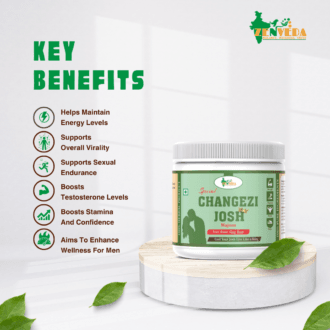
Changezi Josh by Zen Veda is a men’s vitality majoon traditionally used to support stamina, energy and everyday vigour as part of a consistent daily routine. Explore our wider range of Ayurvedic wellness products, or read more on our About Us page.
Want personalised guidance for your wellness routine? Reach out to our team.
Frequently asked questions
Does weakness only come with age?
No, age plays a role but inflammation, inactivity, poor nutrition, chronic stress and inadequate sleep are all major independent contributors at any age.
What is sarcopenia?
Sarcopenia is age-related muscle loss, driven significantly by chronic, low-grade inflammation, which is itself substantially and measurably shaped by everyday lifestyle factors like diet and activity.
Can exercise reverse age-related weakness?
Regular resistance-based activity can meaningfully preserve and even genuinely rebuild strength at almost any age, not merely slow its gradual decline.
Does protein intake matter more with age?
Yes, the body genuinely becomes less efficient at using dietary protein for muscle maintenance with age, making consistently adequate daily intake considerably more important overall.
How does Ayurveda view lasting strength?
Ayurveda ties it to Ojas, built gradually through consistent nourishment, good digestion and steady daily routine, rather than something that simply and automatically fades with age alone.
📚 Sources
1. Bano, G. et al. “Inflammation and sarcopenia: A focus on circulating inflammatory cytokines.” Experimental Gerontology, 2021. PubMed 34478826
2. Charaka Samhita — classical description of Ojas and its role in vitality and strength.
3. Ashtanga Hridayam — classical Ayurvedic reference on daily routine and sustained wellbeing.
2. Charaka Samhita — classical description of Ojas and its role in vitality and strength.
3. Ashtanga Hridayam — classical Ayurvedic reference on daily routine and sustained wellbeing.
Disclaimer: This article is for educational purposes only and is not a substitute for professional medical advice. Individual health conditions vary. If you experience sudden or significant weakness, please consult a qualified healthcare professional.
★ 6,500+ happy customers
Ready to start your Ayurvedic hair journey?
Our Vaidyas build personalised herbal routines for you. Free consultation, no obligation.
For Free Consultation Contact +919548121325, +919149171737 | International business inquiry: sahil@zenveda.co.in / +919548121325
Recommended Zen Veda products
Author
