









- Your cart is empty Browse Shop
📌 Quick facts:
- Ayurveda treats digestion as the foundation of overall health, governed by Agni, the body’s digestive fire, rather than one isolated organ.
- A 2007 review confirms black pepper’s active compound, piperine, has genuine, documented physiological effects on digestion and nutrient absorption.
- Warming spices like ginger, black pepper and cinnamon have long been classical Ayurveda’s go-to tools for supporting sluggish digestion.
- Jawarish Badan combines several of these classical warming herbs in one daily majoon, alongside strengthening herbs for overall vitality.
If you’ve ever wondered how Ayurveda actually views digestion, and why it treats it as so much more than “what happens after you eat,” this guide explains it clearly. We’ll cover the classical concept of Agni, what real research says about the warming spices Ayurveda has always favoured, and how a formula like Jawarish Badan reflects this traditional approach.
Understanding this classical framework genuinely helps make sense of why Ayurvedic advice around food, daily routine and herbs looks so different from a purely modern, nutrient-counting approach to eating — it’s built on a fundamentally different, genuinely whole-body model of how digestion actually works in practice, day to day.
📋 In this guide
- What does Ayurveda actually mean by “digestion”?
- Why does Ayurveda favour warming spices for digestion?
- Does modern research actually support these warming spices?
- What actually weakens Agni in everyday life?
- How does a formula like Jawarish Badan reflect this classical approach?
- How do you actually use Jawarish Badan for these benefits?
- Is it safe to take Jawarish Badan alongside other habits?
- Frequently asked questions
What does Ayurveda actually mean by “digestion”?
⚡ Quick answer: Ayurveda treats digestion as governed by Agni, the body’s digestive fire, which it considers central to overall health, not just one isolated bodily function. Strong, balanced Agni is traditionally linked to good energy, clear skin and general vitality, not just comfortable meals.
Classical Ayurveda genuinely doesn’t treat digestion as a narrow, purely mechanical process confined to the stomach alone — it’s understood through Agni, a considerably broader concept of digestive fire believed to influence how well the entire body processes food, absorbs nutrients, and even manages waste and accumulated toxins over time. This is genuinely why Ayurvedic texts link digestion so closely to overall vitality, energy and even skin health, rather than treating it as a separate, isolated system. Understanding this whole-body framing is the real starting point for understanding almost everything else Ayurveda says about food and daily routine.
Why does Ayurveda favour warming spices for digestion?
⚡ Quick answer: Ayurveda classifies spices like ginger, black pepper and cinnamon as Ushna, or warming, believed to kindle and support Agni directly. This classical logic is exactly why these specific spices appear so consistently across Ayurvedic digestive formulas and home remedies.
Within Ayurveda’s classical framework, spices like ginger, black pepper and cinnamon are categorised as Ushna, warming in nature, and traditionally believed to directly support and kindle Agni when digestion feels sluggish or inconsistent. This is genuinely why these particular spices appear so consistently, not just occasionally, across classical digestive formulas, home remedies and daily routines recommended throughout Ayurvedic texts, rather than being a random or arbitrary selection of common kitchen ingredients chosen simply for flavour. Understanding this deliberate logic behind spice selection genuinely helps explain why so much Ayurvedic dietary advice keeps returning to the same small handful of warming spices again and again, rather than constantly introducing new ones.
Does modern research actually support these warming spices?
⚡ Quick answer: A 2007 review confirms black pepper’s active compound, piperine, has genuine, well-documented physiological effects across multiple bodily systems, including on digestive processes. This gives real research backing to one of the most consistently used spices in classical Ayurvedic digestive formulas, well beyond tradition alone.
A 2007 review published in Critical Reviews in Food Science and Nutrition, comprehensively examining black pepper and its active compound piperine, confirms genuine, well-documented physiological effects across multiple bodily systems, including digestion and nutrient absorption (Srinivasan, 2007). This matters directly for understanding why black pepper appears so consistently in Ayurvedic digestive formulas: it isn’t simply a flavour choice, it’s a spice with real, published research behind its traditional digestive reputation, giving genuine scientific weight to centuries of classical use.
What actually weakens Agni in everyday life?
⚡ Quick answer: Ayurveda traditionally links weakened Agni to irregular meal timing, cold or heavy foods, stress and inconsistent daily routine, rather than any single fixed cause. This whole-lifestyle view is why Ayurvedic digestive advice always extends well beyond diet alone into routine and stress management too.
Classical Ayurveda points to a genuinely broad range of everyday factors as capable of weakening Agni: irregular meal timing, cold or excessively heavy foods, ongoing stress, and an inconsistent daily routine all feature prominently, rather than any single fixed cause being blamed in isolation. This whole-lifestyle view is genuinely why Ayurvedic digestive advice consistently extends well beyond diet alone, into daily routine, sleep and stress management together, treating digestion as connected to how you live overall, not just what you eat at any single meal.
How does a formula like Jawarish Badan reflect this classical approach?
⚡ Quick answer: Jawarish Badan combines warming spices, dried ginger, black pepper and cinnamon, alongside strengthening herbs like Salab and almond, in one daily majoon. It reflects the classical Ayurvedic logic of supporting digestion and overall vitality together, rather than treating them as separate goals.
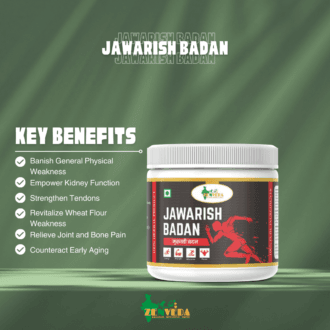
Jawarish Badan by Zen Veda brings together warming spices, dried ginger, black pepper and cinnamon, specifically credited with supporting digestion and circulation, alongside strengthening herbs like Salab, almond and nutmeg for overall vitality, all combined in one daily majoon taken with milk. This reflects exactly the classical Ayurvedic logic discussed throughout this guide: supporting Agni and overall strength together, as connected goals, rather than treating digestion and vitality as two entirely separate concerns needing two entirely separate products.
How do you actually use Jawarish Badan for these benefits?
⚡ Quick answer: Take one-third of a teaspoon of Jawarish Badan with milk before your morning bath and again before bedtime, used consistently every single day. Like most Ayurvedic formulas, genuine results build gradually with daily use, not from a single occasional dose taken sporadically.
The suggested method is straightforward: one-third of a teaspoon taken with milk before your morning bath, and again before bedtime, used consistently as part of a genuine daily routine. If milk isn’t available, it can be taken with water instead. This gradual, twice-daily approach genuinely reflects classical Ayurveda’s broader view that supporting Agni and vitality is a consistent, ongoing daily practice, not a one-time fix reached for only occasionally when convenient.
Is it safe to take Jawarish Badan alongside other habits?
⚡ Quick answer: Jawarish Badan is formulated as a gentle, chemical-free daily tonic, generally well tolerated as part of an ongoing routine. Anyone on medication or managing an existing digestive or medical condition should genuinely check with a qualified Ayurvedic practitioner or doctor before starting.
Because it’s built from named traditional herbs rather than harsh synthetic compounds, Jawarish Badan is generally formulated for ongoing, everyday use as part of a genuine wellness routine. That said, “generally well tolerated” isn’t the same thing as “suitable for absolutely everyone” — anyone currently on medication, or already managing an existing digestive or medical condition, should genuinely check with a qualified Ayurvedic practitioner or doctor before starting, since individual circumstances can genuinely change how any warming herbal formula, however gentle it’s formulated to be, actually interacts with the body over an extended period of time.
Want to genuinely try a whole-formula approach to both digestion and strength together? Explore Jawarish Badan directly from Zen Veda’s own official website today. See our wider range of Ayurvedic wellness products, or read more on our About Us page right here today itself.
Have a genuine question at all before you decide to buy anything? Reach out to our team — we’re genuinely always happy to help.
Frequently asked questions
What does Ayurveda mean by digestion?
It’s governed by Agni, digestive fire, considered central to overall health, energy and vitality, not just comfortable meals.
Why does Ayurveda use warming spices for digestion?
Spices like ginger, pepper and cinnamon are classed as Ushna, warming, and traditionally believed to directly support Agni.
Is there research behind these spices?
Yes, a 2007 review confirms black pepper’s active compound, piperine, has genuine, well-documented physiological effects across multiple systems.
What weakens digestion according to Ayurveda?
Irregular meal timing, heavy or cold foods, stress and inconsistent routine, rather than any single fixed cause.
How should I take Jawarish Badan?
One-third of a teaspoon with milk before your morning bath and again before bedtime, used consistently every day.
📚 Sources
1. Srinivasan, K. “Black pepper and its pungent principle-piperine: a review of diverse physiological effects.” Critical Reviews in Food Science and Nutrition, 2007. PubMed 17987447
2. Charaka Samhita — classical description of Agni (digestive fire) and its role in overall health.
3. Ashtanga Hridayam — classical Ayurvedic reference on Ushna (warming) herbs and their role in digestion.
2. Charaka Samhita — classical description of Agni (digestive fire) and its role in overall health.
3. Ashtanga Hridayam — classical Ayurvedic reference on Ushna (warming) herbs and their role in digestion.
Disclaimer: This article is for educational purposes only and is not a substitute for professional medical advice. Jawarish Badan is a wellness tonic and is not intended to diagnose, treat, cure or prevent any disease. If you are on medication or managing a medical condition, please consult a qualified healthcare professional before use.
★ 6,500+ happy customers
Ready to start your Ayurvedic hair journey?
Our Vaidyas build personalised herbal routines for you. Free consultation, no obligation.
For Free Consultation Contact +919548121325, +919149171737 | International business inquiry: sahil@zenveda.co.in / +919548121325
Recommended Zen Veda products
Author
