


- Your cart is empty Browse Shop
📌 Quick facts:
- Several widely-believed ideas about women’s health don’t hold up under closer scrutiny — and believing them can genuinely delay care.
- A 2021 review in Current Oncology Reports confirms persistent global misconceptions still act as real barriers to women seeking preventive screening.
- Myths about periods, screening, fertility and ageing are among the most common and most persistent.
- Ayurveda treats women’s health as a continuum shaped by life stages, not a single fixed condition to manage reactively.
Women’s health is surrounded by ideas that get repeated so often they start to feel like established fact — even when they aren’t. Some of these myths are simply outdated, but others actively discourage women from seeking care they genuinely need. This guide walks through five of the most common misconceptions, what’s actually true instead, and how Ayurveda frames women’s health across different life stages.
Clearing these up matters because myths rarely stay harmless — they shape real decisions about when to see a doctor, what symptoms to take seriously, and what to simply live with unnecessarily, sometimes for years longer than necessary, purely because a widely repeated idea sounded convincing enough not to question.
📋 In this guide
- Is period pain always something to just tolerate?
- Do only older women need to worry about screening?
- Does irregular fatigue in women always mean “just stress”?
- Is fertility only a concern once trying to conceive?
- Does menopause mean health concerns are basically over?
- How does Ayurveda frame women’s health across life stages?
- Frequently asked questions
Is period pain always something to just tolerate?
⚡ Quick answer: No — while some discomfort is common, severe period pain that disrupts daily life is not something to simply accept as normal. It can be linked to conditions like endometriosis or fibroids, and persistent severe pain genuinely deserves proper medical evaluation rather than silent tolerance.
One of the most persistent myths is that period pain, however severe, is simply part of being a woman and must be quietly endured. Mild to moderate discomfort is genuinely common, but pain severe enough to disrupt work, sleep or daily function is not something to normalise. It can be a sign of underlying conditions such as endometriosis, fibroids or hormonal imbalance, all of which are treatable once identified. Treating severe pain as routine rather than worth investigating is exactly the kind of myth that delays diagnosis, sometimes for years, simply because the pain was assumed to be unremarkable. Many women only discover an underlying condition after finally mentioning pain they’d been quietly living with for a long stretch, describing it almost apologetically, as though it should have been obvious sooner that something was actually wrong.
Do only older women need to worry about screening?
⚡ Quick answer: No. A 2021 review in Current Oncology Reports confirms that misconceptions about age and risk remain a significant barrier to screening globally. Many conditions relevant to women’s health, including certain cancers, can affect younger women too, making age-based assumptions genuinely risky.
A 2021 review published in Current Oncology Reports examines global perceptions around breast cancer and the barriers women face around screening, finding that misconceptions about who is “really” at risk remain widespread and consequential (Vrinten et al., 2021). Age-related risk does increase for many conditions, but that doesn’t mean younger women are exempt — plenty of health concerns, from certain cancers to hormonal disorders, can and do affect women well before the age most people associate with “needing to worry.” Waiting for a birthday milestone before taking screening or symptoms seriously is a genuinely risky habit built on an incomplete picture of actual risk. Age is one factor among several — family history, lifestyle and existing conditions all matter too, and relying on age alone as the trigger for paying attention overlooks the fuller picture entirely.
Does irregular fatigue in women always mean “just stress”?
⚡ Quick answer: Not necessarily. Persistent fatigue is frequently dismissed as stress or being busy, but it can also signal thyroid imbalance, anaemia, or hormonal shifts that are common but under-discussed in women’s health. Ruling out physical causes is worth doing before defaulting to a stress-only explanation.
Persistent tiredness in women is very often chalked up entirely to stress, busy schedules or simply “doing too much” — and while those things certainly contribute, they’re not the whole story. Iron-deficiency anaemia, thyroid imbalances and hormonal fluctuations are all common, physically explainable causes of fatigue that are frequently overlooked because stress feels like the more socially acceptable, expected explanation. This matters because treating fatigue as purely psychological when there’s an underlying physical cause means the actual issue goes unaddressed, sometimes for a long time, while “just rest more” advice fails to help and the real cause continues quietly unchecked in the background.
Is fertility only a concern once trying to conceive?
⚡ Quick answer: No — reproductive health is worth understanding well before it becomes urgent. Conditions affecting fertility, like PCOS or endometriosis, often develop and show signs years earlier, and being aware of them early gives far more options than discovering them only when trying to conceive.
Fertility is often treated as a topic that only becomes relevant once a woman is actively trying to conceive, but many of the conditions that affect fertility — including PCOS, endometriosis and thyroid disorders — typically develop and show signs well before that point. Irregular cycles, unusual pain or other symptoms in earlier years are sometimes brushed aside simply because fertility “isn’t the priority yet.” Being aware of reproductive health earlier doesn’t mean treating every symptom as an emergency, but it does mean noticing patterns sooner, when there are generally more options available to address them, rather than working backward from a fertility conversation that starts with symptoms that had actually been present for years already.
Does menopause mean health concerns are basically over?
⚡ Quick answer: No, quite the opposite in some respects. Menopause brings its own set of health considerations — bone density, heart health and metabolic changes among them — that deserve continued attention rather than being treated as a finish line after which health concerns fade away.
There’s a common assumption that once menopause arrives, the major “women’s health” chapter closes and attention can shift elsewhere. In reality, menopause introduces its own set of considerations that deserve ongoing attention — declining oestrogen affects bone density, cardiovascular health and metabolism in ways that continue to matter for decades afterward. Framing menopause as an endpoint rather than a transition into a different phase of health needs tends to mean these areas get less proactive attention exactly when they deserve more, not less. Regular check-ups, bone density awareness and heart health monitoring remain just as relevant afterward as they were before, even though the conversation around them tends to quietly fade.
How does Ayurveda frame women’s health across life stages?
⚡ Quick answer: Ayurveda views women’s health as a continuum shaped by distinct life stages — menstrual years, reproductive years, and post-menopausal years — each with different dosha considerations, rather than a single static condition to be managed the exact same way throughout an entire lifetime.
Classical Ayurveda approaches women’s health as something that shifts meaningfully across life stages, rather than a fixed state to be managed identically throughout adulthood. Menstrual health, reproductive years and the transition through menopause are each associated with different dosha considerations and different care priorities, particularly around Vata balance as the body moves through hormonal transitions. This framing naturally resists the idea that women’s health is a single box to check once and forget — it treats ongoing attention across each stage as the actual baseline, which lines up well with the reality that needs genuinely do change over time.
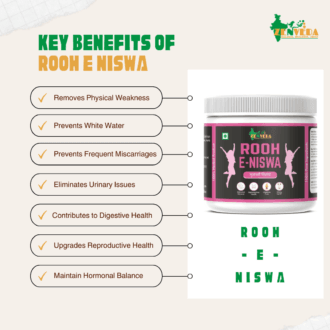
Rooh E Niswa by Zen Veda is an Ayurvedic formulation designed to support women’s health and hormonal balance as part of a consistent daily routine. Explore our wider range of Ayurvedic wellness products, or read more on our About Us page.
Want personalised guidance for your wellness routine? Reach out to our team.
Frequently asked questions
Is severe period pain normal?
No, mild discomfort is common but severe, disruptive pain can signal conditions like endometriosis and deserves proper medical evaluation.
Should only older women worry about health screening?
No, many conditions relevant to women’s health can affect younger women too, making age-based assumptions about risk unreliable.
Is fatigue in women always just stress?
Not always — anaemia, thyroid imbalance and hormonal shifts are common physical causes worth ruling out before assuming it’s purely stress.
Does menopause mean health concerns are over?
No, menopause brings new considerations around bone density, heart health and metabolism that deserve continued attention afterward.
How does Ayurveda approach women’s health differently?
Ayurveda treats women’s health as a continuum across life stages, each with different dosha considerations, rather than one fixed condition.
📚 Sources
1. Vrinten, C. et al. “Global Perceptions of Women on Breast Cancer and Barriers to Screening.” Current Oncology Reports, 2021. PubMed 33937940
2. Charaka Samhita — classical description of Vata dosha and its relationship to women’s reproductive and hormonal transitions.
3. Ashtanga Hridayam — classical Ayurvedic reference on women’s health across life stages.
2. Charaka Samhita — classical description of Vata dosha and its relationship to women’s reproductive and hormonal transitions.
3. Ashtanga Hridayam — classical Ayurvedic reference on women’s health across life stages.
Disclaimer: This article is for educational purposes only and is not a substitute for professional medical advice. Individual health conditions vary. If you experience persistent or severe symptoms, please consult a qualified healthcare professional.
★ 6,500+ happy customers
Ready to start your Ayurvedic hair journey?
Our Vaidyas build personalised herbal routines for you. Free consultation, no obligation.
For Free Consultation Contact +919548121325, +919149171737 | International business inquiry: sahil@zenveda.co.in / +919548121325
Recommended Zen Veda products
Author
