



📌 Quick facts:
- Losing around 50–100 hairs a day is completely normal — and it often looks like more in the shower.
- Washing simply collects and releases hairs that were already loose, so bathing exaggerates, rather than causes, shedding.
- Persistent, heavy shedding can signal telogen effluvium, stress, deficiency or a scalp issue — worth checking.
- Ayurveda links hair health to bhrajaka pitta, nutrition and keshya (hair-supporting) care and oils.
Few things spark instant panic like a fistful of hair in your hand after a shower. It looks alarming — surely you are going bald? For most people, the reassuring truth is that shower shedding is largely an illusion of concentration: bathing gathers together hairs that had already loosened over a day or two and releases them all at once. This guide explains how much hair fall is genuinely normal, why the shower makes it look worse, when shedding actually signals a problem, and how Ayurvedic care and oiling support healthy hair.
That said, hair fall is not always harmless, and knowing the difference matters. So we will look honestly at both sides — when to relax, and when a persistent pattern deserves attention.
📋 In this guide
How much hair fall in the shower is actually normal?
⚡ Quick answer: Losing about 50 to 100 hairs across a whole day is normal for a healthy scalp. On wash days, several days’ worth of already-loosened hairs come out together, so it is common — and normal — to see noticeably more in the shower. The clump in your hand usually reflects accumulation and timing, not sudden new loss.
Every hair on your head follows a natural cycle of growth, rest and shedding, and at any moment a small share is due to fall out and be replaced. For most healthy adults this works out to roughly 50 to 100 hairs a day — hairs you mostly never notice as they drop off one by one onto clothes, pillows and floors. Washing changes the accounting rather than the amount: the physical action of wetting, massaging and rinsing dislodges all the hairs that had already detached but were still resting in place, sometimes from two or three days if you do not wash daily. They then appear together in your hand or the drain, creating a startling clump that is really just normal shedding, collected and delivered all at once.
Why does hair seem to fall more while bathing?
⚡ Quick answer: Because washing physically releases hairs that were already loose. Massaging shampoo, rinsing and towel-drying dislodge resting hairs all at once, and if you wash every few days, several days’ shedding surfaces together. Wet hair also clumps and looks more dramatic. So the shower concentrates normal shedding into one visible moment rather than actually increasing it.
There is simple mechanics behind the shower scare. Throughout the day, hairs that have finished their cycle detach at the root but often stay lodged among the others until something disturbs them. Bathing is that disturbance: massaging shampoo into the scalp, the flow of water, and towel-drying all physically release these already-loose hairs at once. If you wash every second or third day, you are seeing two or three days of shedding in a single wash, which multiplies the visible amount. Wet strands also stick together into clumps that look far more dramatic than the same hairs would scattered across a pillow. So the shower is not accelerating hair loss — it is simply the moment when a few days of perfectly normal shedding becomes visible together.
When is hair shedding a sign of a real problem?
⚡ Quick answer: Be alert if shedding is heavy and persistent for weeks, your hair is visibly thinning, you see widening partings or bald patches, or shedding follows illness, stress, a crash diet or childbirth. Research even uses standardised “wash tests” to measure shedding objectively. If your loss clearly exceeds normal or keeps worsening, it is worth seeing a doctor.
While most shower shedding is harmless, some patterns genuinely warrant attention. The signs that shedding may be more than normal include heavy loss that persists for many weeks, visibly thinning hair or a widening parting, distinct bald patches, or a surge in shedding a couple of months after a trigger such as illness, high fever, major stress, a crash diet, or childbirth — a common, usually temporary condition called telogen effluvium. Interestingly, hair-loss research takes this seriously enough to have developed standardised methods to measure it: a study in Clinical, Cosmetic and Investigational Dermatology (2022) described a refined “wash test” to objectively evaluate hair shedding in alopecia, precisely because collected wash-day hairs are a meaningful signal. The practical rule: occasional shower clumps are fine, but shedding that is clearly excessive, persistent or accompanied by visible thinning deserves a professional assessment. Read the study on PubMed (ID 35115799).
What does Ayurveda say about hair fall?
⚡ Quick answer: Ayurveda links hair health to bhrajaka pitta and asthi dhatu (bone tissue), viewing hair as a by-product of nourishment. Excess heat (pitta), poor digestion, stress and inadequate nutrition are seen as key drivers of hair fall. Care focuses on cooling excess pitta, nourishing the body, and keshya herbs and oils that support the scalp and roots.
| Ayurvedic driver of hair fall | Everyday cause |
|---|---|
| Excess pitta (heat) | Stress, spicy/oily diet, heat |
| Weak agni & poor nourishment | Skipped meals, poor diet |
| Aggravated vata (dryness) | Irregular routine, dry scalp |
| Neglected scalp care | No oiling, harsh products |
Ayurveda regards healthy hair as a reflection of overall nourishment and balance rather than a purely surface matter. Hair (kesha) is considered closely linked to bhrajaka pitta — the aspect of pitta governing the skin and scalp — and to the health of asthi dhatu (bone tissue), of which hair is seen as a by-product. In this framework, excess pitta or heat (from stress, an overly spicy or oily diet, or environmental heat) is a classic driver of hair fall and premature greying, while weak digestion and poor nutrition starve the roots, and aggravated vata brings dryness and brittleness. Ayurvedic care therefore works from the inside and outside together: cooling and balancing pitta, nourishing the body with good food, and using keshya (hair-promoting) herbs and regular oil massage to strengthen the scalp and roots.
How do you reduce excess hair fall naturally?
⚡ Quick answer: Eat a nourishing, protein- and iron-rich diet, manage stress, and sleep well, since these drive the hair cycle. Massage the scalp with a herbal hair oil to improve circulation and nourish roots, be gentle with wet hair, and avoid harsh chemicals and tight styles. Consistency over months is what strengthens hair — quick fixes rarely last.
Because hair growth depends heavily on your overall health, the most effective natural steps address the root, literally and figuratively. Eat a nourishing diet with adequate protein, iron, and vitamins, since deficiencies are a common, often overlooked cause of shedding. Manage stress and protect your sleep, as both strongly influence the hair cycle. Regular scalp massage with a herbal hair oil is a time-honoured Ayurvedic practice that improves circulation to the follicles and nourishes the roots, while also being deeply calming. Be gentle with wet hair, which is more fragile — avoid rough towel-rubbing and tight styling — and steer clear of harsh chemical treatments and excessive heat. None of this delivers overnight results; hair grows slowly, so the benefit comes from patient, consistent care over months.
How does Zen Veda support hair health?
⚡ Quick answer: Zen Veda’s Kesh Vidhi Regrowth Hair Oil is a herbal hair oil made from certified, Uttarakhand-sourced herbs, designed to nourish the scalp and roots and support healthy hair as part of a regular oiling routine. Combined with good nutrition, gentle care and stress management, it offers natural, traditional support for your hair — used consistently over time.
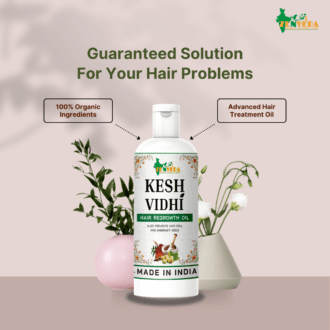
Zen Veda’s hair care is built on this tradition of nourishing, root-focused support. Kesh Vidhi Regrowth Hair Oil is a herbal hair oil crafted from certified, Uttarakhand-sourced herbs, made to nourish the scalp and roots through regular massage as part of a healthy hair routine. As with all hair care, it works best consistently and alongside good nutrition, gentle handling and stress management — not as an overnight cure. Explore the wider Zen Veda range or read more about our approach.
Worried about your hair fall? You can book a free consultation with our Vaidyas for honest, personalised guidance.
Frequently asked questions
How many hairs a day is normal to lose?
Around 50 to 100 hairs a day is normal for a healthy scalp. You will often see more on wash days simply because several days’ worth of already-loose hairs come out together in the shower.
Why do I lose more hair in the shower?
Washing physically releases hairs that had already detached but were resting in place. Massaging, rinsing and towel-drying dislodge them all at once, so the shower concentrates a few days of normal shedding into one visible clump.
Is hair fall reversible?
Often, yes — temporary shedding from stress, illness, deficiency or childbirth usually recovers once the trigger resolves and nutrition improves. Persistent or pattern hair loss is worth assessing early, as earlier care generally gives better results.
Does oiling reduce hair fall?
Regular scalp oiling and massage improve circulation, nourish the roots and reduce breakage, and it is a core Ayurvedic hair practice. It supports healthier hair over time, especially combined with good nutrition and gentle handling.
When should I see a doctor about hair loss?
See a doctor if shedding is heavy and persistent for weeks, your hair is visibly thinning, you notice bald patches, or hair loss comes with other symptoms. These may point to a treatable underlying cause worth identifying.
📚 Sources
1. “Hair Shedding Evaluation for Alopecia: A Refined Wash Test.” Clinical, Cosmetic and Investigational Dermatology, 2022. PubMed 35115799
2. Charaka Samhita — classical descriptions of kesha (hair), bhrajaka pitta and keshya care.
3. Ashtanga Hridayam — classical Ayurvedic reference for hair, scalp and oil-massage regimen.
2. Charaka Samhita — classical descriptions of kesha (hair), bhrajaka pitta and keshya care.
3. Ashtanga Hridayam — classical Ayurvedic reference for hair, scalp and oil-massage regimen.
Disclaimer: This article is for educational purposes only and is not a substitute for personalised medical advice. Individual results vary. Please consult a qualified Ayurvedic practitioner or your healthcare provider before starting any new treatment, especially if you are managing a medical condition or taking medication.
★ 6,500+ happy customers
Ready to start your Ayurvedic hair journey?
Our Vaidyas build personalised herbal routines for you. Free consultation, no obligation.
For Free Consultation Contact +919548121325, +919149171737 | International business inquiry: sahil@zenveda.co.in / +919548121325
Recommended Zen Veda products
-
Hair CareBestseller
 Buy now
Kesh Vidhi is a Bhringraj-based Ayurvedic hair regrowth oil that works at the scalp to reduce hair fall, control dandruff and support natural regrowth. Chemical-free, for men and women — 50ml.
₹900.00
Author


