


- Your cart is empty Browse Shop
📌 Quick facts:
- Leucorrhoea, or likoria, is a genuinely common women’s health concern, though its causes range from everyday and harmless to signs of infection.
- A 2019 population-based study found reproductive tract infections and related symptoms genuinely widespread among women in rural India surveyed.
- Classical Ayurveda addresses leucorrhoea under Shweta Pradara, using cooling, astringent herbs like Lodhra rather than a single isolated treatment.
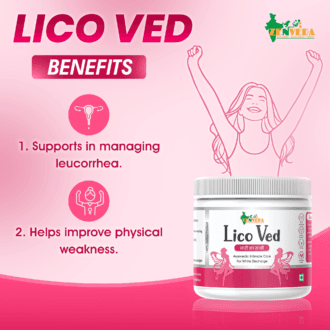
- Lico Ved combines several such traditional herbs, including Supari Dakkni and Nirmali, in one daily wellness formula.
Searching for ayurvedic medicine for leucorrhoea usually means you genuinely want two things clearly explained: what actually causes it, and which herbal approaches genuinely have some real, credible backing behind them. This guide covers both honestly and clearly — what leucorrhoea is, what research says about how common it is and what contributes to it, which herbs classical Ayurveda has traditionally used, and how a formula like Lico Ved fits into that picture.
Understanding the causes clearly, rather than jumping straight to a product, genuinely matters here, because leucorrhoea isn’t always the same underlying thing twice, and knowing that distinction helps you choose the right next step with far more confidence, rather than guessing based on scattered, unreliable information found online or passed along informally.
📋 In this guide
- What exactly is leucorrhoea?
- How common is leucorrhoea, and what does research say about its causes?
- How does classical Ayurveda explain leucorrhoea?
- Which herbs does Ayurveda actually use for leucorrhoea?
- Is it safe to rely on herbal support for an extended period?
- How does a product like Lico Ved fit into this traditional approach?
- When does leucorrhoea need medical attention rather than herbal support?
- Frequently asked questions
What exactly is leucorrhoea?
⚡ Quick answer: Leucorrhoea is a whitish vaginal discharge, commonly called likoria or safed pani in everyday conversation, that many women experience at some point. Classical Ayurveda describes this exact concern as Shweta Pradara, discussed within its broader framework for women’s reproductive wellness.
Leucorrhoea refers to a whitish vaginal discharge that many women experience, often called likoria or safed pani in everyday Hindi conversation. It’s a genuinely broad medical term, covering everything from a normal, harmless part of the menstrual cycle to a symptom linked to infection or imbalance, which is exactly why understanding the likely cause matters more than reaching for a product immediately. Classical Ayurveda has its own dedicated term for this concern, Shweta Pradara, addressed within Yonivyapad, its broader category covering disorders of the female reproductive tract.
How common is leucorrhoea, and what does research say about its causes?
⚡ Quick answer: A 2019 population-based study found reproductive tract infections and related symptoms genuinely widespread among women surveyed in rural India, confirming this is a common, everyday health concern rather than a rare occurrence. Causes range from hygiene and hormonal changes to infections needing proper treatment.
A 2019 study published in the Journal of Family Medicine and Primary Care, a population-based investigation of reproductive tract infections in rural India, found these concerns, including abnormal discharge, genuinely widespread among the women surveyed (Durai et al., 2019). This confirms leucorrhoea is a common, everyday health concern rather than something rare or unusual, though the underlying causes genuinely vary: normal hormonal fluctuations, hygiene practices, weakened digestion in Ayurvedic terms, and in some cases infections that require proper medical diagnosis and treatment rather than herbal support alone.
How does classical Ayurveda explain leucorrhoea?
⚡ Quick answer: Classical Ayurveda links Shweta Pradara to weakened Agni, general bodily imbalance, and inconsistent daily routine, treating it as a whole-body concern rather than an isolated symptom. This traditional framing shapes exactly which herbs and approaches Ayurveda has favoured for centuries.
Within classical Ayurvedic thinking, Shweta Pradara is understood as arising from weakened Agni, digestive fire, alongside broader bodily imbalance and inconsistent daily routine, rather than being treated as an isolated, standalone symptom to suppress. This whole-body framing is genuinely why classical approaches never rely on a single herb in isolation, instead combining cooling, strengthening herbs with attention to diet, routine and digestion together. Understanding this traditional logic helps explain why herbal formulas in this category are typically built as multi-herb combinations rather than single-extract products.
Which herbs does Ayurveda actually use for leucorrhoea?
⚡ Quick answer: Lodhra (Symplocos racemosa) is classical Ayurveda’s most consistently referenced herb for leucorrhoea, valued for its cooling, astringent qualities. Supporting herbs for strength and internal balance are traditionally combined alongside it, genuinely reflecting Ayurveda’s whole-body approach to this concern rather than treating one herb in isolation.
Lodhra, botanically Symplocos racemosa, is genuinely the most consistently referenced herb across classical Ayurvedic literature for leucorrhoea, prized specifically for its cooling, astringent (Kashaya) qualities. Alongside Lodhra, classical formulas traditionally include herbs supporting general strength and internal balance, since Ayurveda treats leucorrhoea as connected to overall wellness rather than one symptom to address in isolation. Modern formulas built on this same logic, combining several named traditional herbs rather than a single extract, remain the most faithful contemporary expression of this classical, whole-formula approach.
Is it safe to rely on herbal support for an extended period?
⚡ Quick answer: A properly formulated Ayurvedic supplement in this category is generally well tolerated for ongoing daily use, but anyone pregnant, nursing, on medication or managing an existing medical condition should genuinely check with a qualified Ayurvedic practitioner or doctor first. This is a sensible precaution rather than a reason to avoid herbal support entirely.
Because classical formulas in this category are built from named traditional herbs rather than harsh synthetic compounds, they’re generally designed for ongoing, everyday use as part of a genuine wellness routine, not a short, intensive course. That said, “generally well tolerated” isn’t the same thing as “suitable for absolutely everyone” — anyone who is pregnant, nursing, currently on medication, or already managing an existing medical condition should genuinely check with a qualified Ayurvedic practitioner or doctor before starting, since individual circumstances can change how any supplement, however gentle, interacts with the body over time.
How does a product like Lico Ved fit into this traditional approach?
⚡ Quick answer: Lico Ved combines Supari Dakkni, Kamar Kas, Nirmali and Maain Kalan & Khurd in one chemical-free daily capsule formula, taken twice daily with warm milk. It genuinely reflects the traditional, multi-herb approach to supporting comfort and internal balance discussed throughout this guide.
Lico Ved by Zen Veda brings together Supari Dakkni, Kamar Kas, Nirmali and Maain Kalan and Khurd, sweetened naturally with Misri, in one chemical-free vegetarian capsule formula, taken as two capsules each morning and two at bedtime with warm milk. This reflects exactly the traditional, whole-formula logic discussed throughout this guide, several complementary herbs supporting comfort and balance together, used consistently as part of a genuine daily routine rather than as an occasional quick fix reached for only when symptoms feel noticeable.
When does leucorrhoea need medical attention rather than herbal support?
⚡ Quick answer: Discharge that’s foul-smelling, discoloured, or accompanied by itching, burning, pelvic pain or fever should be evaluated by a qualified healthcare professional rather than managed with herbs alone. These particular signs can genuinely indicate an infection needing proper medical diagnosis and treatment.
Given how broad the term leucorrhoea genuinely is, recognising when it signals something beyond everyday, manageable discharge matters honestly. Discharge that’s foul-smelling, unusually coloured, or accompanied by itching, burning, pelvic pain or fever is genuinely worth having evaluated by a qualified healthcare professional promptly, since the population research discussed earlier confirms reproductive tract infections are genuinely common and require proper diagnosis, not herbal support alone. A wellness formula like Lico Ved is designed for everyday comfort and balance, not as a substitute for medical care when something feels genuinely unusual.
Want to explore a traditional, whole-formula approach? Explore Lico Ved directly from Zen Veda. See our wider range of Ayurvedic wellness products, or read more on our About Us page.
Have questions? Reach out to our team — we’re happy to help.
Frequently asked questions
What is leucorrhoea?
A whitish vaginal discharge, commonly called likoria, described classically in Ayurveda as Shweta Pradara within its women’s-wellness framework.
How common is leucorrhoea?
Genuinely common — a 2019 population-based study found reproductive tract infections and related symptoms widespread among women surveyed in rural India.
What does Ayurveda say causes leucorrhoea?
Weakened Agni, general bodily imbalance and inconsistent daily routine, treated as a whole-body concern rather than one isolated symptom.
Which herbs does Ayurveda use for leucorrhoea?
Lodhra is the most consistently referenced herb, traditionally combined with herbs supporting strength and internal balance.
When should leucorrhoea be checked by a doctor?
If discharge is foul-smelling, discoloured, or accompanied by itching, pain or fever, have it evaluated by a qualified healthcare professional promptly.
📚 Sources
1. Durai, V. et al. “Reproductive tract infections in rural India – A population-based study.” Journal of Family Medicine and Primary Care, 2019. PubMed 31803656
2. Charaka Samhita — classical description of Shweta Pradara within Yonivyapad (disorders of the female reproductive tract).
3. Ashtanga Hridayam — classical Ayurvedic reference on astringent (Kashaya) herbal formulations for women’s wellness.
2. Charaka Samhita — classical description of Shweta Pradara within Yonivyapad (disorders of the female reproductive tract).
3. Ashtanga Hridayam — classical Ayurvedic reference on astringent (Kashaya) herbal formulations for women’s wellness.
Disclaimer: This article is for educational purposes only and is not a substitute for professional medical advice. Lico Ved is a wellness supplement and is not intended to diagnose, treat, cure or prevent any disease or infection. Persistent, unusual or foul-smelling discharge, or discharge with itching, pain or fever, should be evaluated by a qualified healthcare professional.
★ 6,500+ happy customers
Ready to start your Ayurvedic hair journey?
Our Vaidyas build personalised herbal routines for you. Free consultation, no obligation.
For Free Consultation Contact +919548121325, +919149171737 | International business inquiry: sahil@zenveda.co.in / +919548121325
Recommended Zen Veda products
Author
