




- Your cart is empty Browse Shop
📌 Quick facts:
- Ashwagandha is an adaptogen — best for stress, sleep, strength and recovery. A 2015 trial showed it raised muscle strength and testosterone in men.
- Shilajit is a mineral-rich Himalayan resin — best for energy, stamina and minerals. A 2016 trial showed it raised total and free testosterone.
- They work through different routes, so for many men the honest answer is not “either/or” but “both”.
- Ayurveda favours whole formulas of several vitality herbs over any single isolated extract.
Search “best supplement for men” in India and two names dominate every list: ashwagandha and shilajit. Both are ancient, both are backed by real research, and both are sold as the answer to low energy, poor stamina and flagging vitality. So which one should you actually take? The honest answer is not the one most sellers give — because ashwagandha and shilajit do genuinely different jobs, and the right choice depends entirely on what is actually draining you.
This is a straight, no-hype comparison for Indian men: what each one does, what the science shows, when to choose which, and whether taking both makes sense. No miracle claims — just what the evidence and classical Ayurveda actually support.
📋 In this guide
What does ashwagandha do for men?
⚡ Quick answer: Ashwagandha is an adaptogenic herb that helps the body handle stress. For men it is best known for lowering cortisol, improving strength, muscle recovery and sleep, and supporting healthy testosterone — largely by calming the stress that suppresses it. It suits men who feel burnt out, anxious, poorly rested, or stuck in the gym.
Ashwagandha (Withania somnifera) is classified in Ayurveda as both a rasayana (rejuvenative) and a vajikarana (vitality) herb, and modern science calls it an adaptogen — something that helps the body resist stress. That stress angle is the key to understanding it. Chronic stress and high cortisol quietly wreck men’s energy, sleep, gym gains and testosterone. By calming that stress response, ashwagandha indirectly supports all of them. It is the herb for the modern, overworked, under-slept man whose vitality is being eroded from the inside by pressure rather than by pure physical depletion.
What does shilajit do for men?
⚡ Quick answer: Shilajit is a mineral-rich resin from the Himalayas, prized in Ayurveda as a rejuvenator. For men it is valued for boosting energy, stamina and testosterone, and for delivering fulvic acid and trace minerals that support cellular energy production. It suits men who feel physically drained, low on stamina, or want steady day-long vitality rather than stress relief.
Shilajit is something quite different — not a herb but a mineral-rich resin that seeps from Himalayan rocks, used in Ayurveda for centuries as a powerful rasayana. Its signature compound is fulvic acid, along with a broad spread of trace minerals, and its reputation is built on physical energy and stamina rather than calm. Where ashwagandha works by lowering stress, shilajit works more directly on the body’s energy machinery and mineral reserves. It is the choice for the man who is not so much anxious as simply worn out — low on stamina, physically depleted, wanting steady day-long vigour.
What does the research say about each?
⚡ Quick answer: Both have real evidence. A 2015 trial found men taking ashwagandha for eight weeks gained significantly more muscle strength and a bigger testosterone rise (about 96 versus 18 ng/dL) than placebo. A 2016 trial found purified shilajit taken for 90 days significantly raised total and free testosterone. Different herbs, different routes, both testosterone-supportive.
Encouragingly, both stand up to scrutiny. Wankhede and colleagues ran an 8-week randomized, double-blind, placebo-controlled trial on 57 men in the Journal of the International Society of Sports Nutrition (2015;12:43). The ashwagandha group made significantly greater strength gains (bench-press one-rep max rising about 46 kg versus 26 kg on placebo), added more muscle, recovered better, and saw a markedly larger testosterone increase — roughly 96 ng/dL versus 18 ng/dL. Separately, Pandit and colleagues studied purified shilajit in Andrologia (2016;48(5):570–575): healthy men taking 250 mg twice daily for 90 days showed significant rises in total testosterone, free testosterone and DHEAS, with gonadotropins well maintained. Two different substances, two solid trials, both pointing to genuine benefit. Read them on PubMed: ashwagandha (26609282) and shilajit (26395129).
Ashwagandha vs shilajit: which should you choose?
⚡ Quick answer: Choose by your main problem. If stress, poor sleep, anxiety or gym recovery is your issue, ashwagandha is the better fit. If low physical energy, stamina and mineral depletion are what you feel, shilajit suits you more. Many Indian men have both stress and fatigue — which is exactly why the two are so often combined.
| If your main issue is… | Better fit | Why |
|---|---|---|
| Stress, anxiety, poor sleep | Ashwagandha | Adaptogen that lowers cortisol |
| Gym strength & recovery | Ashwagandha | Proven strength & testosterone gains |
| Low energy & stamina | Shilajit | Fulvic acid & minerals fuel energy |
| Feeling physically depleted | Shilajit | Replenishes mineral reserves |
| Both stress and fatigue | Both together | They cover different roots |
The cleanest way to decide is to name your real problem. If you are wired, poorly slept, anxious and struggling to recover from workouts, your vitality is being drained by stress — ashwagandha is your herb. If you feel flat, physically tired and low on stamina without that mental buzz of stress, your tank is simply empty — shilajit fits better. The catch is that a great many Indian men, juggling long hours, commutes and pressure, genuinely have both problems at once. For them, forcing an either/or choice misses the point.
Can you take ashwagandha and shilajit together?
⚡ Quick answer: Yes, and they complement each other well. Ashwagandha calms the stress and cortisol that drain vitality, while shilajit rebuilds energy and mineral reserves — so together they cover both the mental and physical sides of low vitality. This is why classical Ayurvedic men’s formulas frequently pair them, alongside supporting herbs, rather than relying on either alone.
Not only can you take them together — for many men that is the smarter approach. The two do not overlap; they cover different bases. Ashwagandha addresses the stress-and-cortisol side of low vitality, while shilajit rebuilds the physical, mineral-and-energy side. Used together they tackle both the mental and the bodily roots of feeling run-down. This is exactly the logic behind classical Ayurvedic and Unani men’s formulas, which almost never rely on a single herb. Instead they combine several complementary vitality ingredients, on the principle that a balanced blend does more, and more safely, than any one isolated extract at a high dose.
Which Zen Veda formula is made for Indian men?
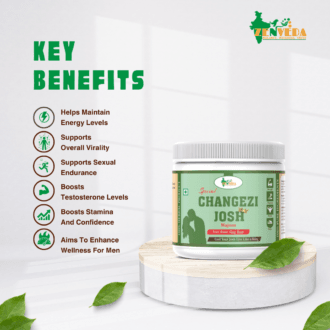
⚡ Quick answer: Beyond ashwagandha and shilajit, Ayurveda and Unani use many vitality herbs. Zen Veda’s Changezi Josh is a men’s majoon combining Yarsa Gumba (Himalayan cordyceps), saffron, safed musli and honey to support stamina, energy and confidence. It reflects the classical, whole-formula approach — a balanced blend of vitality herbs rather than a single isolated extract.
Ashwagandha and shilajit may be the two most famous names, but they are far from the only powerful vitality herbs — and, as we have seen, Ayurveda has always favoured combining several. Zen Veda’s Changezi Josh follows exactly that whole-formula tradition. It is a men’s majoon (a rich herbal paste) built around Yarsa Gumba — the prized Himalayan cordyceps, or keeda jadi — together with saffron, safed musli, Tal Makhana and honey, taken as a quarter-spoon with warm milk at night. Rather than isolating a single extract, it blends complementary stamina-and-vitality herbs in the classical way. Explore the wider Zen Veda range for more men’s wellness options.
Not sure which approach suits your body and lifestyle? You can book a free consultation with our Vaidyas for honest, personalised guidance.
Frequently asked questions
Which is better, ashwagandha or shilajit?
Neither is universally better — they solve different problems. Ashwagandha is best for stress, sleep, strength and recovery; shilajit is best for physical energy, stamina and mineral replenishment. Choose by your main complaint, or use both if you have stress and fatigue together.
Can I take ashwagandha and shilajit together?
Yes. They work through different mechanisms and complement each other — ashwagandha on stress, shilajit on physical energy. Many classical men’s formulas combine several vitality herbs for this reason. If you take medication or have a condition, check with a practitioner first.
Does ashwagandha increase testosterone?
Research supports it. A 2015 trial found men taking ashwagandha for eight weeks had a significantly larger testosterone rise than placebo (about 96 versus 18 ng/dL), alongside greater strength — largely by reducing the stress that suppresses testosterone.
Does shilajit really boost energy?
Shilajit’s fulvic acid and trace minerals support the body’s cellular energy production, and a 2016 trial found purified shilajit significantly raised testosterone over 90 days. Many men report steadier stamina, though quality and purity matter greatly with shilajit.
When should men take these — morning or night?
Ashwagandha is often taken at night to support sleep and recovery, though it can be taken twice daily. Shilajit is usually taken in the morning for energy. Follow the product’s label, and be consistent — benefits build over weeks, not days.
📚 Sources
1. Wankhede S, Langade D, Joshi K, Sinha SR, Bhattacharyya S. “Examining the effect of Withania somnifera supplementation on muscle strength and recovery: a randomized controlled trial.” Journal of the International Society of Sports Nutrition, 2015;12:43. PubMed 26609282
2. Pandit S, Biswas S, Jana U, et al. “Clinical evaluation of purified Shilajit on testosterone levels in healthy volunteers.” Andrologia, 2016;48(5):570–575. PubMed 26395129
3. Charaka Samhita & Ashtanga Hridayam — classical Ayurvedic references on rasayana and vajikarana (rejuvenation and vitality).
2. Pandit S, Biswas S, Jana U, et al. “Clinical evaluation of purified Shilajit on testosterone levels in healthy volunteers.” Andrologia, 2016;48(5):570–575. PubMed 26395129
3. Charaka Samhita & Ashtanga Hridayam — classical Ayurvedic references on rasayana and vajikarana (rejuvenation and vitality).
★ 6,500+ happy customers
Ready to start your Ayurvedic hair journey?
Our Vaidyas build personalised herbal routines for you. Free consultation, no obligation.
For Free Consultation Contact +919548121325, +919149171737 | International business inquiry: sahil@zenveda.co.in / +919548121325
Recommended Zen Veda products
Author
