




- Your cart is empty Browse Shop
📌 Quick facts:
- In Ayurveda, aggravated Pitta — the heat principle — “overheats” the hair roots and is a classic driver of hair fall.
- Modern medicine points to the same culprit from another angle: chronic stress raises cortisol, which pushes hair into the shedding phase.
- A 2012 randomized trial found the Ayurvedic adaptogen ashwagandha significantly lowered serum cortisol (P=0.0006).
- Calming Pitta and lowering cortisol are two names for the same goal: settle the body so follicles hold on.
Arjun’s hair started thinning the same year his job did not let him breathe. Back-to-back deadlines, four hours of sleep, endless coffee, and a short fuse he did not recognise in himself. By the time the appraisal season ended, his hairline had quietly retreated and his pillow was collecting strands. His diet had not changed. His shampoo had not changed. What had changed was his stress — and, without him realising it, the chemistry of his scalp.
Ayurveda would have recognised Arjun instantly as a case of aggravated Pitta. Modern medicine would point to cortisol, the stress hormone. They are describing the same person from two directions — and understanding where they meet is the key to stopping stress-driven hair fall for good.
📋 In this guide
- What is Pitta dosha and how does it affect hair?
- How does stress raise cortisol and cause hair fall?
- What’s the connection between Pitta and cortisol?
- What does the research say about cortisol and hair?
- How do you calm Pitta and lower stress hair fall?
- Which Zen Veda oil helps Pitta-type hair fall?
- Frequently asked questions
What is Pitta dosha and how does it affect hair?
⚡ Quick answer: Pitta is the Ayurvedic principle of heat that governs digestion, hormones and the health of your hair roots. When Pitta runs high — from stress, spicy food, heat and poor sleep — it is said to “overheat” the follicles, weakening them and pushing more hair into early shedding.
Ayurveda organises the body around three doshas, and Pitta is the fiery one — responsible for heat, digestion and transformation. Hair, in Ayurvedic physiology, is closely tied to Pitta: the Charaka Samhita and Ashtanga Hridayam link excess Pitta to Khalitya (hair fall) and Palitya (premature greying). When Pitta is balanced, hair is strong and lustrous. When it is aggravated by stress, heat, skipped meals, spicy-oily food and late nights, that inner “fire” is said to scorch the roots — and the first thing to suffer is your hair.
How does stress raise cortisol and cause hair fall?
⚡ Quick answer: Chronic stress keeps the hormone cortisol elevated. High cortisol pushes hair follicles out of their growth phase and into resting, so weeks later far more strands shed at once — a pattern doctors call telogen effluvium. This is why stressful months are so often followed by a visible surge in hair fall.
Here is the biology behind the feeling. When stress becomes chronic, the adrenal glands keep pumping out cortisol. Sustained high cortisol disrupts the hair cycle, forcing a larger share of follicles prematurely out of their growth phase and into the resting phase. Those hairs cling on for a few weeks and then release together — which is why the heavy shedding often shows up two to three months after the stressful period, long after you think the worst is over. Doctors call this stress-triggered shedding telogen effluvium, and it is one of the most common reversible causes of hair loss.
What’s the connection between Pitta and cortisol?
⚡ Quick answer: Ayurveda described this centuries before cortisol was named. Aggravated Pitta and modern chronic stress point to the same state — an overheated, over-driven system that burns through resources and weakens the hair roots. Seen this way, “cooling Pitta” and “lowering cortisol” are two languages for the same goal: calming the body so follicles can hold on.
It is tempting to treat ancient and modern frameworks as rivals, but here they describe the same physiology. The Pitta-aggravated person — hot-tempered, driven, running on stimulants and too little rest — is, in clinical terms, a person living with chronically elevated cortisol. Both systems agree the problem is not the hair itself but the over-heated, over-stimulated body it grows from. That is genuinely good news, because it means the fix is not a magic topical alone; it is calming the system, from the inside and the outside at once.
What does the research say about cortisol and hair?
⚡ Quick answer: A 2012 randomized, double-blind trial in the Indian Journal of Psychological Medicine gave 64 chronically stressed adults ashwagandha or placebo for 60 days. The ashwagandha group’s serum cortisol fell significantly (P=0.0006) alongside lower stress scores. It is direct evidence that an Ayurvedic adaptogen can lower the very hormone that drives stress-related hair fall.
The link is not just theory. Chandrasekhar, Kapoor and Anishetty ran a prospective, randomized, double-blind, placebo-controlled trial on 64 adults with a history of chronic stress, published in the Indian Journal of Psychological Medicine (2012;34(3):255–262). Over 60 days, the group taking a full-spectrum ashwagandha root extract saw their serum cortisol fall substantially compared with placebo (P=0.0006), along with meaningful drops in stress and anxiety scores. Ashwagandha is a classical Ayurvedic rasayana (rejuvenative) — so this is modern evidence that a traditional Pitta-and-stress remedy measurably lowers the hormone behind stress hair fall. You can read it on PubMed (ID 23439798).
How do you calm Pitta and lower stress hair fall?
⚡ Quick answer: Cool aggravated Pitta with steadier sleep, less caffeine, spice and late nights, and add a daily wind-down like breathing or a short walk. Support the body with adaptogens such as ashwagandha, and give the scalp a twice-weekly warm-oil massage to improve circulation and calm heat at the root.
- Protect your sleep. Cortisol falls with regular, adequate rest; nothing cools Pitta faster than a proper night’s sleep.
- Ease the stimulants. Cut back on caffeine, very spicy and oily food, and late screen-lit nights — all classic Pitta aggravators.
- Add a daily wind-down. Ten minutes of slow breathing, a walk, or meditation directly lowers stress load.
- Use an adaptogen. Ashwagandha is the best-studied Ayurvedic option for lowering cortisol.
- Oil the scalp twice a week. A cooling warm-oil massage soothes heat at the root and improves circulation.
| For calmer Pitta & hair | Pacifies (do more) | Aggravates (do less) |
|---|---|---|
| Sleep | 7–8 hrs, regular timing | Late nights, screens in bed |
| Food | Cooling, freshly cooked meals | Excess spice, oil, caffeine |
| Mind | Breathing, walks, downtime | Constant hustle, no breaks |
| Scalp | Twice-weekly warm oiling | Harsh heat styling, neglect |
Which Zen Veda oil helps Pitta-type hair fall?
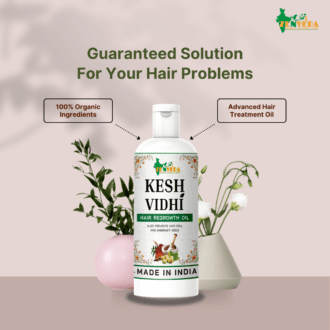
⚡ Quick answer: Zen Veda’s Kesh Vidhi Regrowth Hair Oil pairs Uttarakhand-sourced Bhringraj with cooling keshya herbs chosen to calm an overheated, Pitta-aggravated scalp and nourish stressed roots. Massaged in twice a week, it is the topical half of a Pitta-calming routine — soothing heat at the follicle while your lifestyle changes lower cortisol from within.
Managing stress hair fall works best from both directions: lower cortisol from within, and cool and nourish the scalp from without. Zen Veda’s Kesh Vidhi Regrowth Hair Oil handles the topical half, using Bhringraj and cooling keshya herbs from the Uttarakhand hills to calm an overheated scalp and feed roots left weak by stress. Make it a twice-weekly ritual alongside your sleep and stress changes, and explore the full Zen Veda hair-care range to round out your routine.
If your hair fall is clearly tied to a stressful phase and you want a plan matched to your dosha, you can book a free consultation with our Vaidyas.
Frequently asked questions
Can stress really cause hair fall?
Yes. Chronic stress raises cortisol, which pushes follicles into the resting phase and triggers heavier shedding (telogen effluvium) weeks later. It is one of the most common — and most reversible — causes of sudden hair fall, especially after an intense or draining period.
How do I know if my hair fall is due to Pitta imbalance?
Pitta-type hair fall often comes with signs of excess heat: irritability, acidity, a warm scalp, premature greying, and shedding that worsens during stressful, high-pressure phases. A qualified Ayurvedic practitioner can confirm your dosha balance, but this heat-and-stress pattern is the classic clue.
Does ashwagandha help with hair fall?
Indirectly but meaningfully. Ashwagandha does not grow hair directly, but a 2012 trial showed it significantly lowers cortisol — the hormone driving stress-related shedding. By calming the stress response, it addresses the root cause of Pitta and cortisol-driven hair fall.
How long does stress-related hair fall take to recover?
Once the stress eases and cortisol settles, most people see shedding slow within a few weeks and fuller regrowth over three to six months. Consistency with sleep, stress management and scalp care shortens the recovery noticeably.
Can cooling my Pitta stop hair fall?
Cooling Pitta through better sleep, calmer routines, cooling foods, adaptogens and scalp oiling directly targets the heat-and-stress state behind this type of hair fall. It will not fix genetic balding, but for stress-driven shedding it addresses the actual cause.
📚 Sources
1. Chandrasekhar K, Kapoor J, Anishetty S. “A prospective, randomized double-blind, placebo-controlled study of safety and efficacy of a high-concentration full-spectrum extract of ashwagandha root in reducing stress and anxiety in adults.” Indian Journal of Psychological Medicine, 2012;34(3):255–262. PubMed 23439798
2. Charaka Samhita & Ashtanga Hridayam — classical Ayurvedic references on Pitta, Khalitya (hair fall) and rasayana (rejuvenatives).
2. Charaka Samhita & Ashtanga Hridayam — classical Ayurvedic references on Pitta, Khalitya (hair fall) and rasayana (rejuvenatives).
★ 6,500+ happy customers
Ready to start your Ayurvedic hair journey?
Our Vaidyas build personalised herbal routines for you. Free consultation, no obligation.
For Free Consultation Contact +919548121325, +919149171737 | International business inquiry: sahil@zenveda.co.in / +919548121325
Recommended Zen Veda products
Author

3 Comments
White Discharge: When Is It Normal and When Not?
July 10, 2026[…] Pitta dosha and hair fall: the cortisol connection […]
Fatty Liver on Your Report? What to Do Next
July 10, 2026[…] Pitta dosha and hair fall: the cortisol connection […]
Early Signs of PCOS You Shouldn't Ignore
July 10, 2026[…] Pitta dosha and hair fall: the cortisol connection […]