









- Your cart is empty Browse Shop
📌 Quick facts:
- “Tila oil” is a herbal massage oil, traditionally used for external application to support circulation, comfort and relaxation.
- A 2005 review in Sports Medicine confirms massage genuinely influences circulation, muscle recovery and perceived relaxation.
- It’s meant for topical, external massage — not an ingestible tonic or supplement.
- Ayurveda frames oil massage (abhyanga) as a daily self-care ritual rather than an occasional treatment.
“Tila oil” is a term that comes up often in searches around men’s Ayurvedic self-care, yet many people aren’t entirely sure what it actually is or how it’s meant to be used. This guide explains what a tila (massage) oil does, what the evidence around massage actually shows, and how Ayurveda frames this kind of daily oiling ritual.
Getting a clear picture matters because massage oils are often searched for with vague or urgent expectations, when understanding what they realistically do — and don’t do — leads to a far more satisfying and consistent self-care routine. Many people come across the term through word of mouth or a product listing without ever seeing it clearly explained, which leaves plenty of room for assumptions to fill the gap, not all of them accurate.
📋 In this guide
- What exactly is tila oil used for?
- Does massage actually do anything, scientifically speaking?
- How should a massage oil actually be applied?
- What should realistic expectations look like?
- Who should be cautious about using a massage oil?
- How does Ayurveda frame daily oil massage?
- Frequently asked questions
What exactly is tila oil used for?
⚡ Quick answer: Tila oil refers to a herbal massage oil applied externally to the body, typically used to support local circulation, comfort and relaxation as part of a men’s self-care routine. It’s a topical product, not something taken internally, and is meant to be massaged gently into the skin.
“Tila” broadly refers to oil-based Ayurvedic preparations meant for external massage, and in men’s wellness contexts, tila oils are typically formulated to support comfort, relaxation and local circulation through gentle, deliberate topical application rather than a quick, hurried rub. This distinguishes it clearly from an ingestible supplement or tonic — the entire mechanism is external, working through the skin and underlying tissue via massage rather than through digestion or absorption into the bloodstream in the way a tablet or majoon would. Understanding this distinction upfront avoids a common mix-up, where someone expects an internal, systemic effect from a product that was only ever designed to work at the surface level, through touch and topical application.
Does massage actually do anything, scientifically speaking?
⚡ Quick answer: Yes. A 2005 review in Sports Medicine confirms massage has measurable effects on circulation, muscle recovery and perceived relaxation, even though the exact mechanisms are still being refined. This gives a genuine physiological basis to why massage-based self-care feels beneficial beyond simple placebo.
A widely cited 2005 review published in Sports Medicine examines the physiological mechanisms behind massage, concluding that it does produce measurable effects on local circulation, muscle recovery and subjective relaxation, even as researchers continue refining exactly how these effects occur (Weerapong et al., 2005). This matters because it validates massage as more than just a pleasant ritual — there’s a real physiological basis for why consistent massage tends to leave muscles feeling less tense and skin feeling more cared for, distinct from any specific oil’s ingredient list. The oil itself plays a supporting role here too, reducing friction so the massage motion can be sustained comfortably for longer, while also moisturising skin that would otherwise dry out from repeated hand contact.
How should a massage oil actually be applied?
⚡ Quick answer: Apply a small amount to clean, dry skin and massage gently using circular motions, working from the extremities toward the centre of the body. Consistency matters more than pressure — a gentle, regular routine tends to be more effective than occasional vigorous rubbing.
Technique genuinely affects how much benefit a massage oil delivers. A small amount applied to clean, dry skin, massaged in with gentle circular motions and generally worked from the extremities toward the centre of the body, tends to be the more effective approach than applying too much oil and rubbing too hard. Consistency also matters considerably more than intensity — a calm, regular five-to-ten-minute routine several times a week tends to build the kind of cumulative benefit that a single, occasional vigorous session simply can’t replicate. Many people default to pressing harder when they don’t notice an immediate effect, when the more useful adjustment is usually showing up more often rather than pressing down harder on any single occasion.
What should realistic expectations look like?
⚡ Quick answer: A herbal massage oil is best understood as a comfort and relaxation-supporting self-care product, not a medical treatment or a guaranteed fix for any specific condition. Setting expectations around gentle, cumulative comfort rather than dramatic results leads to a far more satisfying, sustainable routine.
It’s worth being upfront: a massage oil, however well-formulated, is a self-care and comfort-supporting product, not a medical treatment for any specific diagnosis. Expecting a dramatic, singular transformation from any oil sets up disappointment regardless of the product used. What consistent use realistically offers is a gentler, more comfortable daily ritual, incremental support for local circulation, and a few quiet minutes of intentional self-care — genuinely valuable outcomes, just different from what an urgent, results-focused search query might be hoping to find. Reframing the goal this way tends to make the routine easier to sustain too, since it’s no longer being measured against an unrealistic bar it was never designed to clear.
Who should be cautious about using a massage oil?
⚡ Quick answer: Anyone with broken or irritated skin, known allergies to specific herbal ingredients, or an existing medical condition should check the ingredient list carefully and speak with a doctor first. A small patch test before full-body use is a simple, sensible precaution for anyone trying a new oil, taking only a day to complete.
As with any topical product, sensible caution applies. Broken, irritated or actively inflamed skin isn’t a good candidate for massage until it heals. Anyone with known sensitivities to specific herbal ingredients should review the full ingredient list carefully first, and those managing an existing medical condition should check with a doctor before beginning a new routine. A simple patch test on a small area of skin, waited on for 24 hours, is a low-effort way to catch any reaction before applying an oil more broadly across the body.
How does Ayurveda frame daily oil massage?
⚡ Quick answer: Ayurveda treats oil massage, abhyanga, as a daily self-care ritual rather than an occasional or purely reactive treatment. It’s traditionally linked to supporting Vata dosha balance, and its value is understood to come from consistent, everyday practice rather than sporadic use.
Classical Ayurveda places daily oil massage, abhyanga, among its core recommended self-care routines, traditionally understood to help balance Vata dosha — associated with movement, dryness and nervous system activity. Unlike a purely cosmetic or occasional-use lens, Ayurveda frames this as a daily practice, ideally woven into a morning or evening routine rather than reached for only when discomfort arises. This consistency-first mindset lines up closely with what the physiological research on massage also suggests: cumulative, regular practice tends to matter more than any single application. Building it into an existing habit, such as right after a shower or before bed, tends to be the most reliable way of actually sustaining it long enough for the cumulative benefits to show up.
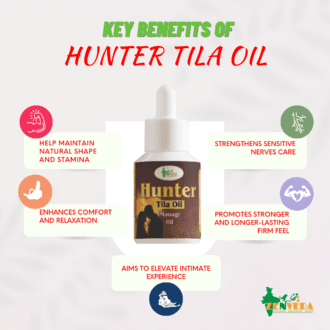
Hunter Tila by Zen Veda is a chemical-free Ayurvedic herbal massage oil for men, made for gentle external massage as part of a daily self-care ritual. Explore our wider range of Ayurvedic wellness products, or read more on our About Us page.
Want personalised guidance for your self-care routine? Reach out to our team.
Frequently asked questions
What is tila oil used for?
It’s a herbal massage oil used externally to support local circulation, comfort and relaxation as part of a men’s self-care routine.
Is massage actually backed by research?
Yes, a 2005 review confirms massage has measurable effects on circulation, muscle recovery and relaxation, giving it a genuine physiological basis.
How often should a massage oil be used?
Consistency matters more than intensity — a gentle, regular routine several times a week tends to work better than occasional vigorous use.
Can massage oil treat a medical condition?
No, it’s a self-care and comfort-supporting product, not a medical treatment, and shouldn’t be relied on for diagnosing or treating conditions.
How does Ayurveda view daily oil massage?
Ayurveda treats abhyanga as a daily self-care ritual supporting Vata dosha balance, valued for consistent practice rather than occasional use.
📚 Sources
1. Weerapong, P. et al. “The mechanisms of massage and effects on performance, muscle recovery and injury prevention.” Sports Medicine, 2005. PubMed 15730338
2. Ashtanga Hridayam — classical Ayurvedic reference for abhyanga (daily oil massage) and Vata dosha balance.
3. Charaka Samhita — classical description of oil-based external therapies in daily self-care.
2. Ashtanga Hridayam — classical Ayurvedic reference for abhyanga (daily oil massage) and Vata dosha balance.
3. Charaka Samhita — classical description of oil-based external therapies in daily self-care.
Disclaimer: This article is for educational purposes only and is not a substitute for professional medical advice. Individual skin sensitivities vary. If you have broken skin, known allergies or an existing medical condition, please consult a qualified healthcare professional before use.
★ 6,500+ happy customers
Ready to start your Ayurvedic hair journey?
Our Vaidyas build personalised herbal routines for you. Free consultation, no obligation.
For Free Consultation Contact +919548121325, +919149171737 | International business inquiry: sahil@zenveda.co.in / +919548121325
Recommended Zen Veda products
Author
