







- Your cart is empty Browse Shop
📌 Quick facts:
- Discharge with itching is a different signal than discharge alone — the combination points toward an underlying cause worth identifying.
- A 2025 review confirms yeast infections (candidiasis) are among the most common causes of vaginal itching alongside discharge, and generally respond quite well to correct, timely treatment.
- Itching alone, without discharge changes, can also stem from irritation, allergies or skin conditions unrelated to infection.
- Ayurveda links this combination to aggravated Kapha and Pitta dosha together, genuinely reflecting both excess moisture and irritation.
Discharge on its own is often entirely unremarkable, but when itching joins in as well, it understandably raises considerably more concern than either symptom would cause alone, and rightly so, given what it can signal. This guide explains clearly why itching alongside discharge is a meaningfully different signal worth paying real attention to, what commonly causes it, and how Ayurveda genuinely approaches this particular combination of symptoms.
Understanding this distinction genuinely matters because itching combined with discharge usually points toward a specific, identifiable and generally very treatable underlying cause, rather than something to quietly endure or guess about for weeks on end, hoping it eventually resolves by itself without any intervention at all.
📋 In this guide
- Why is itching alongside discharge different from discharge alone?
- What’s the most common cause of this combination?
- What other causes should be considered?
- Can itching occur without any change in discharge?
- What can be done at home while waiting to see a doctor?
- How does Ayurveda understand itching combined with discharge?
- Frequently asked questions
Why is itching alongside discharge different from discharge alone?
⚡ Quick answer: Discharge alone is often just normal, hormonally-driven variation that comes and goes, but itching signals irritation or inflammation is genuinely present too, and that’s worth noting. This combination is a more specific and useful clue than either symptom in isolation, and generally points toward a definable, treatable cause rather than ordinary hormonal fluctuation.
Discharge by itself is frequently a normal, hormonally-influenced occurrence that fluctuates through the menstrual cycle without indicating anything wrong. Itching changes that picture meaningfully, since it signals genuine irritation or active inflammation of the tissue, something normal, ordinary discharge alone doesn’t typically cause on its own. This combination is actually a more useful diagnostic clue than either symptom alone — it narrows down the likely causes considerably and generally points toward something specific and identifiable, rather than leaving the picture vague and open to guesswork or unnecessary worry.
What’s the most common cause of this combination?
⚡ Quick answer: A 2025 review confirms yeast infections (vulvovaginal candidiasis) are among the most frequent causes of itching combined with discharge, often described as thick and white. These infections are common, well understood, and generally respond quickly to appropriate antifungal treatment once correctly identified.
A 2025 review on vaginitis diagnosis and treatment, published in American Family Physician, confirms quite clearly that yeast infections, or vulvovaginal candidiasis, are among the very most common causes of this itching-plus-discharge combination, often accompanied by thick, white discharge and noticeable, sometimes uncomfortable irritation of the surrounding tissue (Paladine & Desai, 2025). The genuinely reassuring part of this finding is how common and well-understood these infections are — they’re not rare or mysterious, and they respond reliably to correct antifungal treatment once properly identified, usually within a matter of days rather than weeks.
What other causes should be considered?
⚡ Quick answer: Bacterial imbalances, certain sexually transmitted infections, and simple irritation from soaps, detergents or synthetic fabric can all genuinely cause this exact combination too, in different ways. Each of these tends to have a fairly distinct pattern of discharge colour, smell and texture, which is exactly why proper evaluation matters considerably more than simply guessing from symptoms alone at home.
Beyond yeast infections specifically and quite commonly, bacterial imbalances, certain sexually transmitted infections, and straightforward irritant reactions to scented soaps, leftover laundry detergent residue or synthetic underwear fabric can all genuinely produce itching alongside discharge as well. Each of these tends to have a somewhat distinct pattern — differences in discharge colour, consistency, texture and odour — that an experienced healthcare provider can reliably distinguish through simple examination or basic testing. This is precisely why self-diagnosing from a symptom description alone, without any proper evaluation, is genuinely unreliable; several different causes can look remarkably similar from the outside, even to someone paying close, careful attention to every detail. A quick, simple swab test in a clinic setting is usually all it genuinely takes to tell them apart with real, lasting confidence.
Can itching occur without any change in discharge?
⚡ Quick answer: Yes, this genuinely happens often — itching without any notable discharge change can stem from simple skin irritation, allergic reactions to products, ordinary dryness, or certain unrelated skin conditions that have nothing to do with infection at all. This distinction genuinely matters a great deal because the appropriate response differs considerably depending on whether discharge is actually involved.
Itching doesn’t always come paired with a genuinely meaningful, noticeable change in discharge pattern or amount. Skin irritation, allergic reactions to a newly introduced soap, lotion or laundry product, general ongoing dryness, or certain dermatological conditions can all cause noticeable itching in the area without any real, measurable shift in discharge pattern at all. Distinguishing between these two scenarios matters a great deal practically, since the appropriate response — simply switching a product versus actively seeking treatment for an infection — differs considerably depending on which is genuinely happening, making an accurate assessment genuinely worthwhile rather than something to skip in favour of guessing based on what worked for a friend or a forum post read late at night.
What can be done at home while waiting to see a doctor?
⚡ Quick answer: Avoid scented soaps, douching and tight synthetic clothing, wear breathable cotton underwear, and resist the genuine urge to scratch, which can noticeably worsen irritation. These simple, low-effort, everyday steps support genuine comfort without interfering with a doctor’s ability to accurately diagnose the actual underlying cause properly later.
While arranging an appointment to see a doctor, a few simple, low-effort steps genuinely help with comfort in the meantime without complicating the eventual diagnosis in any way. Avoiding scented soaps, douching products and tight synthetic clothing genuinely reduces additional, unnecessary irritation in the area. Breathable, well-fitted cotton underwear genuinely supports a healthier local environment generally, day to day. Resisting the urge to scratch, while genuinely difficult in the moment, prevents further irritation and potential skin breakdown that can make an eventual diagnosis more complicated. It’s genuinely worth avoiding over-the-counter treatments before an actual diagnosis, since using the wrong product for the wrong cause can mask symptoms and complicate an accurate assessment later, sometimes delaying proper treatment further still and prolonging the discomfort unnecessarily in the meantime.
How does Ayurveda understand itching combined with discharge?
⚡ Quick answer: Ayurveda links this combination to aggravated Kapha dosha, associated with excess moisture and heaviness, alongside Pitta dosha, associated with heat and irritation. Balancing both through diet, herbs and lifestyle is the traditional approach, alongside recognising when proper medical evaluation is genuinely needed.
Classical Ayurveda associates this particular combination of symptoms — discharge together with itching — with aggravated Kapha dosha, linked closely to excess moisture and heaviness, occurring alongside Pitta dosha imbalance, associated with heat, inflammation and irritation. This dual-dosha framing reflects the two-part nature of the symptom itself: moisture-related discharge alongside heat-related irritation. Traditional approaches focus on balancing both through appropriate diet, supportive herbs and sensible lifestyle adjustments, while treating proper diagnosis as a genuinely necessary complement rather than something herbal support alone should ever attempt to replace entirely on its own.
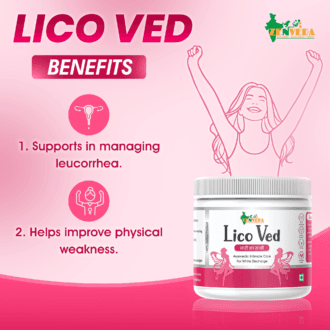
Lico Ved by Zen Veda is an Ayurvedic formulation designed to support women’s vaginal health and balance as part of a consistent daily routine. Explore our wider range of Ayurvedic wellness products, or read more on our About Us page.
Want personalised guidance for your wellness routine? Reach out to our team.
Frequently asked questions
Why does discharge sometimes come with itching?
Itching signals irritation or inflammation is present, often pointing toward a specific, identifiable and generally very treatable underlying cause worth checking.
What’s the most common cause of itching with discharge?
Yeast infections (candidiasis) are among the most common causes, and generally respond well and quickly to correct antifungal treatment once identified.
Can itching happen without discharge changes?
Yes, skin irritation, allergic reactions or ordinary dryness can all cause itching without any real, noticeable change in discharge pattern.
What should I avoid while waiting to see a doctor?
Avoid scented soaps, douching, tight synthetic clothing and unverified over-the-counter treatments before getting a proper diagnosis first.
How does Ayurveda view this combination of symptoms?
Ayurveda links it to combined Kapha and Pitta dosha imbalance, addressed through mindful diet, supportive herbs and appropriate medical evaluation together.
📚 Sources
1. Paladine, H. L. & Desai, U. A. “Vaginitis: Diagnosis and Treatment.” American Family Physician, 2025. PubMed 41252833
2. Charaka Samhita — classical description of Kapha and Pitta dosha in reproductive health.
3. Ashtanga Hridayam — classical Ayurvedic reference on women’s health and dosha balance.
2. Charaka Samhita — classical description of Kapha and Pitta dosha in reproductive health.
3. Ashtanga Hridayam — classical Ayurvedic reference on women’s health and dosha balance.
Disclaimer: This article is for educational purposes only and is not a substitute for professional medical advice. Individual conditions vary. If you experience itching, unusual discharge or discomfort, please consult a qualified healthcare professional.
★ 6,500+ happy customers
Ready to start your Ayurvedic hair journey?
Our Vaidyas build personalised herbal routines for you. Free consultation, no obligation.
For Free Consultation Contact +919548121325, +919149171737 | International business inquiry: sahil@zenveda.co.in / +919548121325
Recommended Zen Veda products
Author
