



- Your cart is empty Browse Shop
📌 Quick facts:
- Ayurveda approaches women’s health through dosha balance, healthy Artava (menstrual/reproductive function) and strong Agni (digestive fire) rather than treating symptoms in isolation.
- Vata dosha is considered central to menstrual regularity, which is why irregular cycles are traditionally linked to Vata imbalance.
- A 2024 literature review examined Ayurvedic herbal medicines and their applications in female reproductive health, reflecting growing research interest.
- Ayurveda emphasises life-stage care — treating adolescence, reproductive years and menopause as distinct phases needing different support.
Ayurveda has one of the oldest continuous frameworks for understanding women’s health, developed over centuries and organised around principles quite different from modern medicine. Rather than treating individual symptoms separately, it looks at digestion, dosha balance and life stage together. This guide explains how Ayurveda actually views women’s health, what modern research says about its herbs, and how the classical framework maps onto everyday concerns.
Understanding this framework is genuinely useful, because it explains why Ayurvedic advice for a menstrual concern might focus on diet and routine rather than the symptom itself — an approach that often puzzles people who arrive expecting a far more direct and immediate fix.
📋 In this guide
- What is the core Ayurvedic framework for women’s health?
- Why is Vata dosha so central to menstrual health?
- Does modern research support Ayurvedic herbs for women’s health?
- How does Ayurveda approach different life stages?
- Why does Ayurveda focus so much on digestion?
- How can women apply this framework practically?
- Frequently asked questions
What is the core Ayurvedic framework for women’s health?
⚡ Quick answer: Ayurveda centres women’s health on the balance of the three doshas, the health of Artava (reproductive tissue and menstrual function), and the strength of Agni (digestive fire). These are treated as interconnected, so a concern in one area is understood to reflect imbalance in the others.
Classical Ayurveda organises women’s health around a few interconnected concepts. The three doshas — Vata, Pitta and Kapha — govern the body’s functional patterns. Artava refers to the reproductive tissue and menstrual function. Agni, the digestive fire, determines how well food becomes healthy tissue. Crucially, these aren’t separate systems: weak digestion is understood to affect tissue quality, which affects reproductive health, which affects overall vitality. This is why Ayurvedic consultations often ask about digestion and sleep when the presenting concern is menstrual. To someone expecting questions only about their cycle, this can feel like a detour — but within the framework it’s the most direct route available, since the cycle is understood to reflect the state of everything upstream of it.
Why is Vata dosha so central to menstrual health?
⚡ Quick answer: Vata dosha governs movement and rhythm in the body, including the cyclical timing of menstruation. Because of this, irregular cycles, cramping and unpredictable timing are classically attributed to aggravated Vata, and traditional care focuses on grounding, warming and regularising practices.
Vata governs all movement and rhythm in the body, from circulation to the timing of biological cycles. Because menstruation is fundamentally a rhythmic, cyclical process involving downward movement, Ayurveda considers it primarily Vata-governed. This is why irregularity, unpredictable timing, dryness and cramping pain are classically linked to aggravated Vata — typically driven by irregular routine, excessive stress, insufficient rest or a cold, dry, light diet. The traditional response is correspondingly grounding: warmth, regularity, adequate rest and nourishing food. It’s notable how well this maps onto what many women observe in practice — cycles often become less predictable during periods of travel, disrupted sleep or unusual stress, which is precisely what a Vata-based explanation would anticipate.
Does modern research support Ayurvedic herbs for women’s health?
⚡ Quick answer: Research interest is genuinely growing. A 2024 literature review examined Ayurvedic herbal medicines and their applications in female reproductive health, reviewing the evidence base. This reflects real scientific engagement, though evidence strength varies considerably between individual herbs and specific conditions.
A 2024 literature review published in Cureus examined Ayurvedic herbal medicines and their applications in female reproductive health (Patel et al., 2024). Reviews like this reflect genuine and growing scientific interest in herbs Ayurveda has used for centuries. It’s worth being straightforward, though: the strength of evidence varies considerably between individual herbs and specific conditions, and a review noting traditional applications is not the same as conclusive proof for every use. It is best read as genuinely encouraging context rather than as a settled scientific conclusion about any particular formulation.
How does Ayurveda approach different life stages?
⚡ Quick answer: Ayurveda treats adolescence, the reproductive years, pregnancy, postpartum and menopause as distinct phases with different dominant doshas and different needs. Menopause, for instance, is understood as a naturally Vata-predominant stage, which directly shapes the dietary and lifestyle guidance traditionally offered during it.
One genuinely distinctive feature of the Ayurvedic approach is its emphasis on life stages. Adolescence, the reproductive years, pregnancy, the postpartum period and menopause are each understood as phases with different dosha predominance and correspondingly different needs. Menopause, for example, is regarded as a naturally Vata-predominant stage of life, which explains why traditional guidance emphasises grounding, warming, nourishing practices during it. Postpartum care similarly receives detailed classical attention, with warm foods, oil massage and rest prescribed as recovery rather than optional comfort. This structured attention to the weeks after childbirth is one area where the classical framework is notably more detailed than much conventional advice, which often focuses heavily on pregnancy itself and comparatively little on the recovery period that follows it.
Why does Ayurveda focus so much on digestion?
⚡ Quick answer: Because Ayurveda holds that all bodily tissues, including reproductive tissue, are ultimately built from properly digested food. Weak Agni is therefore seen as an upstream cause of poor tissue quality, meaning digestive support is often the starting point even for concerns that seem unrelated to the gut.
The emphasis on digestion can seem puzzling when the concern is menstrual or hormonal, but it follows logically from Ayurvedic tissue theory. All dhatus (tissues) are understood to form sequentially from properly digested food, beginning with Rasa (nourishing fluid) and progressing through to Artava (reproductive tissue). Weak Agni therefore compromises the entire chain. This is the reasoning behind starting with digestion: without it, even excellent food and herbs deliver limited benefit to the tissues that need them most. In practical terms, this is why a practitioner may suggest addressing bloating, irregular appetite or sluggish digestion first, treating those as the foundation on which any further support is built rather than as unrelated complaints to be handled separately later.
How can women apply this framework practically?
⚡ Quick answer: Prioritise regular routine and meal timing, favour warm nourishing food over cold and dry, get adequate rest particularly around menstruation, and support digestion. These reflect the framework’s core priorities and work alongside, not instead of, appropriate medical care for specific conditions.
Practically, the framework translates into a few consistent priorities: keeping a regular daily routine and meal timing to settle Vata, favouring warm, freshly prepared, nourishing food over cold, dry or heavily processed options, allowing adequate rest particularly around menstruation, and supporting digestion generally. Traditional women’s wellness formulations are used alongside these foundations. Importantly, none of this replaces appropriate medical care — persistent or severe symptoms warrant proper investigation regardless of which framework you find most helpful.
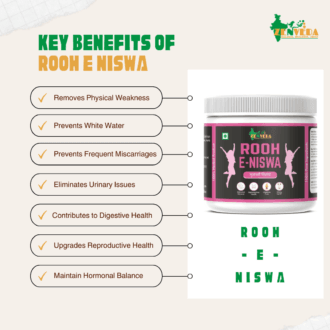
Rooh E Niswa by Zen Veda is a women’s wellness tonic of classical herbs traditionally used to support feminine health, strength and everyday vitality. Explore our wider range of Ayurvedic wellness products, or read more on our About Us page.
Want personalised guidance rooted in this framework? Book a free consultation with our Vaidyas.
Frequently asked questions
How does Ayurveda view women’s health?
Through the balance of the three doshas, the health of Artava (reproductive function) and the strength of Agni (digestive fire), treated as interconnected rather than separate.
Why is Vata linked to menstrual problems?
Vata governs movement and rhythm, including cyclical timing, so irregular cycles, cramping and unpredictable periods are classically attributed to aggravated Vata.
Is there research on Ayurvedic herbs for women?
Yes, a 2024 literature review examined Ayurvedic herbal medicines in female reproductive health, though evidence strength varies between individual herbs and conditions.
Does Ayurveda treat menopause differently?
Yes, menopause is understood as a naturally Vata-predominant life stage, which is why guidance emphasises grounding, warming and nourishing practices during it.
Why does Ayurveda focus on digestion for hormonal issues?
Because all tissues, including reproductive tissue, are understood to form from properly digested food, making weak Agni an upstream cause of poor tissue quality.
Can Ayurveda replace medical care for women’s health?
No — it works best alongside appropriate medical care, and persistent or severe symptoms always warrant proper medical investigation regardless of approach.
📚 Sources
1. Patel, S. et al. “Ayurvedic Herbal Medicines: A Literature Review of Their Applications in Female Reproductive Health.” Cureus, 2024. PubMed 38558676
2. Charaka Samhita — classical description of Artava, dhatus and Agni in women’s health.
3. Ashtanga Hridayam — classical Ayurvedic reference for life-stage care and Vata balance.
2. Charaka Samhita — classical description of Artava, dhatus and Agni in women’s health.
3. Ashtanga Hridayam — classical Ayurvedic reference for life-stage care and Vata balance.
Disclaimer: This article is for educational purposes only and is not a substitute for personalised medical advice. Individual results vary. Please consult a qualified Ayurvedic practitioner or your healthcare provider before starting any new treatment, especially if you are pregnant, breastfeeding, or managing a medical condition.
★ 6,500+ happy customers
Ready to start your Ayurvedic hair journey?
Our Vaidyas build personalised herbal routines for you. Free consultation, no obligation.
For Free Consultation Contact +919548121325, +919149171737 | International business inquiry: sahil@zenveda.co.in / +919548121325
Recommended Zen Veda products
Author
